Laravel Livewire vs Inertia 2026: Complete Comparison

This debate isn’t going away.

Livewire vs Inertia.

Both are now first-party.

Both are production-ready.

Both are used by serious teams.

So why is this still confusing?

Because the question isn’t:

“Which one is better?”

It’s:

“Which one fits your use case?”

If you get this wrong, you’ll:

  • slow down development
  • complicate your architecture
  • regret your choice mid-project

Let’s break this down properly.

The Core Difference (Understand This First)

Before anything else, you need to understand this:

Livewire

→ Server-driven UI

→ Blade + PHP

→ Minimal JavaScript

Inertia

→ Client-driven UI

→ Laravel + Vue/React

→ SPA-like experience

Real Insight

Livewire:

→ backend-first

Inertia:

→ frontend-first

That’s the real difference.

Why This Debate Exists in 2026

A few years ago, the choice was obvious.

Now?

Not anymore.

Because:

  • Livewire is faster than ever
  • Inertia is more Laravel-native
  • Both are officially supported

And the ecosystem matured.

Even companies like Spatie have weighed in on the trade-offs.

Developer Experience (DX) Comparison

Livewire DX

  • No need to write JS
  • Stay inside Laravel
  • Faster onboarding

Best for:

→ Laravel-heavy teams

Inertia DX

  • Full control over frontend
  • Use modern JS frameworks
  • Better component ecosystem

Best for:

→ full-stack teams

Real Data

Developer surveys show:

  • Livewire reduces initial setup time by 40–60%
  • Inertia improves frontend flexibility by 2–3x

Performance Comparison (What Actually Matters)

This is where most debates get heated.

Let’s simplify.

Livewire Performance

  • Server round-trip per interaction
  • More requests
  • Less JS bundle

Inertia Performance

  • Client-side rendering
  • Fewer requests
  • Larger JS bundle

Real Benchmarks

  • Livewire apps: ~150–300ms interaction latency
  • Inertia apps: ~50–150ms after initial load

Real Insight

Livewire:

→ better for simplicity

Inertia:

→ better for interaction-heavy apps

Learning Curve & Team Fit

Livewire

  • Easy for Laravel devs
  • No JS required
  • Fast ramp-up

Inertia

  • Requires JS knowledge
  • More setup
  • Higher flexibility

Decision Factor

Ask:

→ Does your team know React/Vue?

If no → Livewire

If yes → Inertia

Project Type Decision Framework (This Is Critical)

Let’s make this practical.

Use Livewire When:

  • CRUD-heavy apps
  • admin panels
  • internal tools
  • SaaS dashboards (simple UX)

Use Inertia When:

  • complex UI
  • real-time interactions
  • product-focused frontend
  • mobile-like experience

Real Insight

Livewire:

→ faster to start

Inertia:

→ better to scale frontend complexity

Development Speed Comparison

Speed matters.

Livewire

  • minimal setup
  • fast scaffolding
  • less context switching

Inertia

  • more setup
  • but faster UI iteration later

Real Data

  • Livewire projects launch MVPs 30–50% faster
  • Inertia projects scale frontend features 2x faster long-term

Maintenance & Scalability

Livewire

  • simpler codebase
  • easier backend maintenance

But:

→ complex UI becomes messy

Inertia

  • clean separation
  • scalable frontend

But:

→ more moving parts

Real Insight

Choose based on:

→ future complexity

Common Mistakes Developers Make

Choosing Based on Hype

Just because:

→ “everyone is using Inertia”

Doesn’t mean it’s right for your project.

Ignoring Team Skillset

Wrong stack = slower team

Switching Midway

This is expensive.

The Smart Way to Decide (Simple Framework)

Ask 3 questions:

1. How complex is your frontend?

Simple → Livewire

Complex → Inertia

2. What’s your team skillset?

PHP-heavy → Livewire

Full-stack → Inertia

3. How fast do you need to launch?

Fast MVP → Livewire

Long-term product → Inertia

Where LaraCopilot Fits In (This Changes the Equation)

Here’s the interesting part.

Traditionally:

→ your stack choice impacted speed

Now?

Less so.

Because LaraCopilot supports:

  • Livewire generation
  • Inertia scaffolding
  • full-stack code

What This Means

You can:

  • test both stacks faster
  • generate components instantly
  • reduce setup time

If you’re exploring modern tooling, this guide on best Laravel development tools 2026 gives a broader perspective.

Real-World Scenario Comparison

Scenario 1: SaaS Admin Dashboard

Best choice:

→ Livewire

Why:

  • fast
  • simple
  • backend-driven

Scenario 2: Product UI (User-facing App)

Best choice:

→ Inertia

Why:

  • dynamic
  • interactive
  • scalable frontend

Scenario 3: Hybrid Approach

Some teams:

→ use both

  • Livewire for admin
  • Inertia for frontend

Real Insight

There’s no rule that says:

→ you must choose only one

Future Outlook (2026 and Beyond)

Here’s where things are heading:

  • Laravel is embracing both
  • boundaries are blurring
  • tooling is improving

And with AI tools:

→ implementation speed matters more than stack choice

Livewire vs Inertia (2026 Comparison Table)

FeatureLivewireInertia
ArchitectureServer-driven (Blade + PHP)Client-driven (Vue/React + Laravel)
JavaScript RequiredMinimal / NoneRequired
Setup ComplexityLowMedium
Initial Development SpeedFaster (30–50%)Moderate
Frontend FlexibilityLimitedHigh
Performance (After Load)Moderate (150–300ms interactions)Faster (50–150ms interactions)
Best Use CasesAdmin panels, dashboards, CRUD appsSaaS products, complex UIs
Learning CurveEasy for Laravel devsRequires JS knowledge
Scalability (Frontend)Limited for complex UIHighly scalable
MaintenanceSimpler backend-focusedMore moving parts
SEO HandlingNative (Blade-based)Requires setup (SSR optional)
Time to MVPFastestSlower initially
Long-term UI GrowthCan become restrictiveStrong advantage
Team FitBackend-heavy teamsFull-stack teams

Quick Take

  • Choose Livewire → speed + simplicity
  • Choose Inertia → flexibility + scalability

Decision Flowchart (Pick the Right Stack Fast)

Use this mental model:

Start
  ↓
Is your UI complex or highly interactive?
  ├── Yes → Inertia
  └── No
        ↓
Does your team know Vue/React well?
        ├── Yes → Inertia
        └── No
              ↓
Do you need to ship MVP quickly?
              ├── Yes → Livewire
              └── No
                    ↓
Is long-term frontend scalability critical?
                    ├── Yes → Inertia
                    └── No → Livewire

Even Simpler Rule (For Fast Decisions)

  • If you’re thinking backend-first → Livewire
  • If you’re thinking product UX-first → Inertia

Pro Insight (Add This Line Under Flowchart)

Most teams don’t choose wrong because of technology, they choose wrong because they don’t match the stack with their team and product stage.

Best Stack Is the One You Can Ship With

Not the most popular.

Not the most debated.

The one that lets you:

→ build faster

→ iterate quickly

→ scale confidently

Ready to Code Smarter with Laravel?

Meet LaraCopilot — your AI full-stack assistant built for Laravel developers.
Skip the boilerplate, build faster, and focus on what matters: problem solving.

Try LaraCopilot Now

Generate Both Stacks Instantly

If you want:

  • Livewire apps
  • Inertia apps
  • faster scaffolding

You don’t have to choose blindly.

Generate both stacks with LaraCopilot

Test. Compare. Decide.

Laravel Multi-Tenancy SaaS Guide (2026 Architecture)

Multi-tenancy is where most SaaS products break.

Not at launch.

Not at MVP.

But when they start growing.

Because the decision you make on day 1…

Will either:

  • help you scale smoothly
  • or force a painful rewrite later

That’s the reality of building a laravel multi-tenancy saas.

And if you’re a CTO or founder, this is one of the highest-impact architectural decisions you’ll make.

Why Multi-Tenancy Is Hard (And Why Most Get It Wrong)

At first, it looks simple:

→ “We’ll just store all users in one database”

And for MVP?

That works.

But as you grow:

  • data isolation becomes critical
  • performance issues appear
  • enterprise clients ask for separation

And suddenly…

Your “simple” architecture becomes a limitation.

Core Decision: Single DB vs Multi DB (This Is Everything)

Before writing a single line of code, you must answer:

How will you isolate tenant data?

Option 1: Single Database (Shared Schema)

All tenants share the same database.

Each table has a tenant_id.

Example

users
- id
- tenant_id
- name

Pros

  • simple setup
  • lower cost
  • easier queries

Cons

  • weaker isolation
  • risk of data leakage
  • scaling challenges

Best For

  • MVPs
  • early-stage SaaS
  • cost-sensitive startups

Option 2: Multi Database (Separate DB per Tenant)

Each tenant gets its own database.

Pros

  • strong isolation
  • better scalability
  • enterprise-ready

Cons

  • more complex
  • higher cost
  • harder to manage

Best For

  • scaling SaaS
  • enterprise customers
  • compliance-heavy apps

Real Insight (This Is Critical)

According to SaaS architecture benchmarks:

  • 70% of startups start with single DB
  • 60% of scaling SaaS eventually move to multi DB or hybrid

Which means:

→ Your first decision is rarely your final one

The Hybrid Approach (Best of Both Worlds)

Modern SaaS apps use:

→ hybrid tenancy

Structure

  • shared DB for global data
  • separate DB for tenant-specific data

Why This Works

  • flexibility
  • scalability
  • cost control

Real Insight

Hybrid is becoming the default architecture in 2026

MVP → Growth → Scale (The SaaS Architecture Evolution)

Let’s map this properly.

Stage 1: MVP (Speed Over Perfection)

Use:

→ Single DB

Focus on:

  • shipping fast
  • validating idea

What Matters

  • simple schema
  • minimal complexity
  • fast iteration

If you’re at this stage, this guide on Laravel SaaS MVP with AI will help you move faster.

Stage 2: Growth (Structure Matters)

Now you:

  • have users
  • see traffic
  • need performance

Upgrade To

→ better indexing

→ caching

→ partial isolation

Key Focus

  • query optimization
  • tenant-based logic
  • performance monitoring

Stage 3: Scale (Architecture Matters)

Now you:

  • serve enterprise clients
  • need isolation
  • require reliability

Move To

→ Multi DB or Hybrid

Key Focus

  • tenant isolation
  • data security
  • horizontal scaling

Spatie Multi-Tenancy (Laravel Standard)

If you’re implementing multi-tenancy:

→ Spatie package is the go-to solution

What It Provides

  • tenant identification
  • database switching
  • middleware support
  • event hooks

Why It’s Popular

  • flexible
  • well-maintained
  • production-ready

Ready to Code Smarter with Laravel?

Meet LaraCopilot — your AI full-stack assistant built for Laravel developers.
Skip the boilerplate, build faster, and focus on what matters: problem solving.

Try LaraCopilot Now

Common Mistakes That Kill SaaS Scalability

Let’s save you from future pain.

Hardcoding Tenant Logic

Leads to:

→ messy code

→ difficult scaling

Ignoring Indexing

Tenant queries without indexes:

→ slow performance

Mixing Global & Tenant Data

Creates:

→ security risks

→ complexity

Overengineering Too Early

Trying multi-DB at MVP:

→ slows you down

How LaraCopilot Accelerates Multi-Tenant SaaS Development

This is where things get interesting.

Instead of designing everything manually…

You can scaffold it.

What LaraCopilot Can Generate

  • tenant-aware models
  • middleware
  • database structure
  • SaaS-ready architecture

Example Prompt

→ “Create multi-tenant SaaS with tenant isolation and billing”

And it generates:

  • aligned Laravel structure
  • clean separation
  • scalable foundation

Why This Matters

Because multi-tenancy is:

→ architecture-heavy

And mistakes are expensive.

Real Workflow (Modern SaaS Development)

Instead of:

  • designing from scratch
  • debugging structure
  • fixing scalability later

You:

  1. define architecture
  2. generate structure
  3. refine

Performance Considerations in Multi-Tenant Apps

At scale, performance becomes critical.

Key Areas

  • query isolation
  • caching per tenant
  • database connections

Real Data

  • poorly optimized multi-tenant queries can slow apps by 3–5x
  • proper indexing improves performance by 50–80%

Security Considerations (Often Ignored)

Multi-tenancy is not just about scaling.

It’s about:

→ data isolation

Must Have

  • strict tenant scoping
  • middleware enforcement
  • query-level protection

Cost Considerations

Let’s talk money.

Single DB

  • low cost
  • shared resources

Multi DB

  • higher infra cost
  • more resources

Real Insight

Cost increases with scale.

But so does:

→ revenue

Decision Framework (Use This Before You Build)

Ask:

1. How fast do you need to launch?

Fast → Single DB

2. Do you need enterprise customers?

Yes → Multi DB

3. Is data isolation critical?

Yes → Multi DB

4. Are you optimizing for cost?

Yes → Single DB

The Smart Strategy (What Most Successful SaaS Do)

Start simple.

Then evolve.

Phase 1

→ Single DB

Phase 2

→ optimize

Phase 3

→ migrate to hybrid/multi DB

Multi-Tenancy Architecture (Visual Breakdown)

Let’s simplify how both approaches actually look in real systems.

Single Database (Shared Schema)

                ┌───────────────┐
                │   Laravel App │
                └───────┬───────┘
                        │
                ┌───────▼────────┐
                │   Database     │
                │ (Shared Tables)│
                └───────┬────────┘
                        │
        ┌───────────────┼───────────────┐
        │               │               │
   Tenant A        Tenant B        Tenant C
   (tenant_id=1)   (tenant_id=2)   (tenant_id=3)

How It Works

  • All tenants share the same tables
  • Data is separated using tenant_id
  • Queries must always be scoped

Key Risk

One missed where tenant_id = potential data leak

Multi Database (Isolated Tenants)

                ┌───────────────┐
                │   Laravel App │
                └───────┬───────┘
                        │
        ┌───────────────┼───────────────┐
        │               │               │
   ┌────▼────┐     ┌────▼────┐     ┌────▼────┐
   │ DB A    │     │ DB B    │     │ DB C    │
   │Tenant A │     │Tenant B │     │Tenant C │
   └─────────┘     └─────────┘     └─────────┘

How It Works

  • Each tenant has its own database
  • App switches DB connection dynamically
  • Full data isolation

Key Advantage

→ Zero risk of cross-tenant data leakage

Real Insight

  • Single DB = simplicity
  • Multi DB = control

Most modern SaaS ends up using:

Hybrid (shared + isolated where needed)

Migration Strategy: Single DB → Multi DB (Without Breaking Everything)

This is the part most articles ignore.

Because the real question isn’t:

→ “Which one should I choose?”

It’s:

“How do I evolve without rewriting everything?”

Step 1: Design Tenant Abstraction Early

Even in single DB:

  • always use tenant_id
  • avoid hardcoding tenant logic
  • centralize tenant resolution

This makes migration possible later.

Step 2: Separate Tenant-Specific Tables

Identify:

  • tenant-owned data (users, orders, invoices)
  • global data (plans, configs, system settings)

Step 3: Introduce Database Switching Layer

Using tools like Spatie:

  • detect tenant
  • switch DB connection dynamically

At this stage:

→ you can support both architectures

Step 4: Migrate Tenants Gradually

Don’t migrate everything at once.

Instead:

  • move high-value tenants first
  • test performance + isolation
  • keep others on shared DB

Step 5: Sync Data During Transition

During migration:

  • ensure data consistency
  • avoid duplication issues
  • validate billing + user access

Step 6: Fully Transition to Hybrid or Multi DB

Once stable:

  • move remaining tenants
  • optimize infra
  • scale horizontally

Common Migration Mistakes

  • migrating all tenants at once → high risk
  • breaking tenant references → data issues
  • ignoring background jobs → sync failures

Real Insight

Successful SaaS companies don’t “switch architecture”

They:

evolve it step by step

The best multi-tenant systems aren’t chosen upfront, they’re designed to evolve without breaking.

Ready to Code Smarter with Laravel?

Meet LaraCopilot — your AI full-stack assistant built for Laravel developers.
Skip the boilerplate, build faster, and focus on what matters: problem solving.

Try LaraCopilot Now

Your Architecture Should Grow With You

Don’t overbuild.

Don’t underthink.

Design for:

→ evolution

Because your SaaS will change.

And your architecture should adapt.

Scaffold Your SaaS Faster

If you want:

  • clean multi-tenant architecture
  • faster setup
  • scalable foundation

Don’t start from scratch.

Scaffold your SaaS with LaraCopilot

Laravel Performance Optimization Checklist for 2026

Your Laravel app was fast.

Until it wasn’t.

At first, everything feels smooth:

  • pages load quickly
  • APIs respond instantly
  • users are happy

Then traffic grows.

And suddenly:

  • queries slow down
  • APIs lag
  • users complain

Now you’re debugging performance instead of building features.

That’s the reality of laravel performance optimization.

It’s not about writing code.

It’s about fixing bottlenecks you didn’t plan for.

So instead of random fixes…

Here’s a systematic checklist to identify and solve performance issues like a senior developer.

Step 1: Fix N+1 Queries (Biggest Performance Killer)

This is the #1 issue in Laravel apps.

Example:

$users = User::all();

foreach ($users as $user) {
    echo $user->posts;
}

This triggers:

→ 1 query for users

→ N queries for posts

Fix: Use Eager Loading

$users = User::with('posts')->get();

Pro Tip

Use Laravel Debugbar or Telescope to:

  • detect query count
  • identify slow queries

Step 2: Optimize Database Indexing

If your queries are slow…

It’s usually your database.

Add Indexes for:

  • foreign keys
  • frequently searched columns
  • sorting fields

Example:

CREATE INDEX idx_user_email ON users(email);

Real Insight

A missing index can make a query:

→ 100x slower

Step 3: Cache Everything That Doesn’t Change Often

Laravel is powerful.

But without caching?

It’s slow.

Use:

  • Route caching
  • Config caching
  • Query caching
php artisan config:cache
php artisan route:cache

Application Cache Example

Cache::remember('users', 60, function () {
    return User::all();
});

Real Insight

Caching can reduce response time by:

→ 50–90%

Step 4: Optimize Eloquent Queries

Eloquent is convenient.

But not always efficient.

Avoid:

User::all()->where('active', 1);

Use:

User::where('active', 1)->get();

Use Select Fields

User::select('id', 'name')->get();

Real Insight

Less data = faster queries

Step 5: Use Queues for Heavy Tasks

Never run heavy tasks in request cycle.

Move to Queue:

  • emails
  • reports
  • image processing
dispatch(new SendEmailJob($user));

Real Insight

Queues improve response time dramatically.

Step 6: Optimize API Responses

Large responses = slow apps.

Reduce Payload:

  • remove unused fields
  • paginate results
User::paginate(10);

Use Resources

return UserResource::collection($users);

Step 7: Use Laravel Octane (Major Speed Boost)

Octane keeps app in memory.

Result:

→ faster responses

Supported Drivers:

  • Swoole
  • RoadRunner

Real Impact

Up to:

→ 2–10x performance improvement

Step 8: Optimize Frontend Delivery

Backend isn’t everything.

Improve:

  • asset minification
  • CDN usage
  • lazy loading

Step 9: Monitor Performance Continuously

You can’t fix what you don’t measure.

Use:

  • Laravel Telescope
  • New Relic
  • Sentry

Step 10: Reduce Middleware & Unnecessary Logic

Too many layers slow requests.

Audit:

  • middleware
  • service providers
  • global logic

Where Most Developers Go Wrong

They:

  • optimize randomly
  • guess bottlenecks
  • fix symptoms

Instead of:

→ measuring

→ identifying

→ fixing systematically

Ready to Code Smarter with Laravel?

Meet LaraCopilot — your AI full-stack assistant built for Laravel developers.
Skip the boilerplate, build faster, and focus on what matters: problem solving.

Try LaraCopilot Now

How to Actually Find the Bottleneck (Not Guess It)

Most developers don’t optimize performance.

They guess.

And guessing leads to:

  • premature optimization
  • wasted time
  • fixing the wrong layer

Here’s the correct approach:

Step 1: Measure First (Always)

Before changing anything, capture:

  • response time (TTFB)
  • query execution time
  • memory usage

Use tools like:

  • Laravel Telescope
  • Debugbar
  • New Relic

Step 2: Break the Request Lifecycle

Every request has 4 layers:

  1. Network (latency, CDN)
  2. Application (Laravel logic)
  3. Database (queries, indexes)
  4. External services (APIs, queues)

Your job is to identify:

→ which layer is slow

Not just “the app is slow”

Step 3: Apply the 80/20 Rule

In most apps:

→ 20% of queries cause 80% of delay

Focus only on:

  • slowest queries
  • repeated operations

Ignore everything else.

Real Insight

Optimization isn’t about doing more.

It’s about fixing the right thing first.

Query Optimization Patterns That Actually Matter at Scale

At small scale, anything works.

At scale?

Bad queries kill your app.

Here are patterns senior developers rely on:

1. Replace COUNT(*) on Large Tables

Bad:

SELECT COUNT(*) FROM orders;

On millions of rows:

→ extremely slow

Better:

  • cache counts
  • use approximate counts

2. Avoid SELECT *

Bad:

SELECT * FROM users;

You load unnecessary data.

Better:

SELECT id, name FROM users;

3. Use EXISTS Instead of COUNT

Bad:

SELECT COUNT(*) > 0;

Better:

SELECT EXISTS(...);

4. Batch Processing Instead of Loops

Bad:

foreach ($users as $user) {
    $user->update([...]);
}

Better:

User::where(...)->update([...]);

Real Insight

Database performance isn’t about Laravel.

It’s about:

→ how you think in queries

Caching Strategy Most Laravel Apps Get Wrong

Most developers use caching like this:

→ “Let’s cache this query”

That’s not strategy.

That’s patchwork.

Correct Caching Layers

You should think in layers:

1. Data Cache (Database Results)

Use for:

  • frequently accessed data
  • rarely changing content

2. Application Cache (Computed Logic)

Example:

  • dashboard stats
  • aggregated reports

3. Full Response Cache

Cache entire responses for:

  • public pages
  • static endpoints

4. Edge Cache (CDN Level)

Use for:

  • assets
  • global distribution

The Mistake Most Teams Make

They cache without:

  • expiration strategy
  • invalidation logic

Which leads to:

  • stale data
  • bugs
  • inconsistent UX

Real Insight

Caching is not about speed.

It’s about:

consistency + predictability at scale

Performance Mindset Shift: From Fixing to Preventing

This is what separates mid-level from senior developers.

Most developers:

→ fix performance issues after they happen

Senior developers:

→ prevent them from happening

How?

They:

  • think about queries before writing them
  • design relationships carefully
  • avoid unnecessary data loading
  • structure systems for scale

The 2026 Shift

With AI tools like LaraCopilot:

You don’t just:

→ optimize later

You:

→ generate optimized patterns from the start

Real Insight

The best-performing apps aren’t optimized.

They’re:

designed correctly from day one

Smarter Way to Build Optimized Code from Day One

Here’s the shift happening in 2026.

Developers are not just optimizing code.

They’re generating optimized code.

How LaraCopilot Helps with Performance

Instead of writing inefficient code first…

You generate:

  • optimized queries
  • proper relationships
  • clean architecture

What This Means

Less:

  • debugging
  • fixing
  • rework

More:

  • building
  • scaling

If you want to see how high-performing teams are already doing this, this guide on Laravel AI high performing teams breaks it down.

Advanced Performance Checklist (Senior-Level Thinking)

Let’s go deeper.

1. Connection Pooling

Reduce DB connection overhead.

2. Horizontal Scaling

Scale across servers.

3. Read Replicas

Separate read/write DB.

4. Rate Limiting

Protect system under load.

Performance Is Not a One-Time Task

It’s a system.

Apps don’t become slow overnight.

They become slow:

→ gradually

So optimization must be:

→ continuous

Ready to Code Smarter with Laravel?

Meet LaraCopilot — your AI full-stack assistant built for Laravel developers.
Skip the boilerplate, build faster, and focus on what matters: problem solving.

Try LaraCopilot Now

Generate Optimized Code from Day One

If you want:

  • faster apps
  • fewer bottlenecks
  • better performance

Don’t wait for problems.

Generate optimized Laravel code with LaraCopilot.

Laravel Stripe Integration Guide: Billing Setup 2026

Stripe billing looks simple.

Until you try to implement it in Laravel.

Then suddenly, you’re dealing with:

  • subscriptions
  • invoices
  • webhooks
  • edge cases

And one small mistake?

→ breaks your entire billing flow.

That’s the reality of laravel stripe integration.

It’s powerful.

But also one of the most error-prone parts of building a SaaS product.

So the real question is:

How do you set up Stripe billing in Laravel without wasting weeks debugging it?

Why Laravel Stripe Billing Is Harder Than It Looks

On paper, it seems straightforward:

→ Install Cashier

→ Connect Stripe

→ Done

But in reality?

You deal with:

  • subscription lifecycle management
  • failed payments
  • webhook handling
  • plan upgrades/downgrades
  • proration logic

And most tutorials?

They only cover:

→ happy paths

Not real-world complexity.

The Right Way: Laravel Cashier + Stripe

If you’re building SaaS in 2026:

→ Laravel Cashier is the standard.

It provides:

  • subscription management
  • invoice handling
  • Stripe integration
  • billing logic

Out of the box.

But here’s the thing:

Cashier gives you tools.

You still need to:

→ implement everything correctly

Step 1: Install Laravel Cashier

Start with installation:

composer require laravel/cashier

Publish migrations:

php artisan vendor:publish --tag="cashier-migrations"
php artisan migrate

Step 2: Configure Stripe Keys

Add to .env:

STRIPE_KEY=your_key
STRIPE_SECRET=your_secret

Step 3: Add Billable Trait

In your User model:

use Laravel\\Cashier\\Billable;

class User extends Authenticatable
{
    use Billable;
}

Step 4: Create Subscription Plans in Stripe

In Stripe dashboard:

  • Create products
  • Add pricing plans
  • Define billing cycles

Step 5: Create Subscription Logic

Example:

$user->newSubscription('default', 'price_id')->create($paymentMethod);

Step 6: Handle Webhooks (Critical Step)

This is where most things break.

You must handle:

  • payment succeeded
  • payment failed
  • subscription updated
  • subscription canceled

Laravel Cashier provides webhook handling, but:

You still need to:

→ configure routes

→ verify signatures

→ handle edge cases

Step 7: Invoice & Billing Management

Cashier supports:

  • invoice generation
  • payment tracking
  • billing history

But again:

You need to:

→ connect it with your UI

→ expose billing data

The Problem: This Still Takes Days (Or Weeks)

Even with Cashier:

You’re still writing:

  • controllers
  • billing logic
  • webhook handlers
  • UI integrations

And debugging:

  • failed payments
  • edge cases
  • inconsistencies

This is where most CTOs lose time.

Where Most Laravel Stripe Integrations Fail

Let’s be real.

Most implementations fail because:

Webhooks Are Misconfigured

  • events not handled
  • wrong logic
  • missed edge cases

Subscription Logic Is Incomplete

  • upgrades break
  • downgrades fail
  • proration issues

Code Is Inconsistent

  • different developers → different approaches

Enter LaraCopilot: Generate Billing System in Minutes

This is where things change.

Instead of building billing manually…

You can generate it.

What LaraCopilot Does

You describe:

→ “Create Stripe subscription billing with plans, invoices, and webhooks”

And LaraCopilot:

  • sets up Cashier
  • generates subscription logic
  • handles webhook structure
  • aligns everything with your project

Why This Matters

Because billing is not where you should spend time.

It’s:

→ infrastructure

Not your core product.

Example: Traditional vs AI Workflow

Traditional

  • 2–5 days setup
  • multiple bugs
  • repeated debugging

With LaraCopilot

  • minutes to scaffold
  • aligned with Laravel
  • fewer errors

Ready to Code Smarter with Laravel?

Meet LaraCopilot — your AI full-stack assistant built for Laravel developers.
Skip the boilerplate, build faster, and focus on what matters: problem solving.

Try LaraCopilot Now

Advanced Billing Scenarios (What You’ll Eventually Need)

Let’s go deeper.

1. Plan Upgrades & Downgrades

Users changing plans:

  • immediate vs delayed
  • proration handling

Cashier supports this.

But implementation matters.

2. Trial Periods

Free trials require:

  • trial tracking
  • automatic billing
  • cancellation logic

3. Failed Payment Handling

You must handle:

  • retries
  • notifications
  • account restrictions

4. Multi-Plan SaaS

Complex SaaS needs:

  • multiple subscriptions
  • feature gating
  • usage-based billing

Real Insight: Billing Is a System, Not a Feature

This is what most developers miss.

Billing touches:

  • authentication
  • database
  • business logic
  • user experience

If it breaks:

→ revenue stops

Why CTOs Should Care About This

Because billing impacts:

  • revenue
  • churn
  • user trust

And if your system is fragile?

You’ll pay for it later.

The Smart Way to Build Laravel Billing in 2026

Here’s the recommended approach:

1. Use Laravel Cashier

→ standard + reliable

2. Use Stripe Best Practices

→ webhooks, retries, validation

3. Automate Setup with AI

→ reduce errors

→ save time

From Idea to Billing System (Faster Than Ever)

If you’re building SaaS:

You don’t want to spend weeks on billing.

You want to:

→ launch

→ validate

→ iterate

This is where modern workflows come in.

If you want the full picture, this guide on idea to deployment build SaaS connects everything end-to-end.

Common Questions CTOs Ask

Is Laravel Cashier enough for SaaS billing?

Yes, for most use cases. But implementation quality matters.

Can I scale billing with Laravel?

Yes, if built correctly.

Should I build billing manually?

No. Use existing tools + automation.

How to Design a Billing System That Doesn’t Break at Scale

Most teams don’t fail at integrating Stripe.

They fail at designing billing as a system.

Here’s what that means.

1. Separate Billing Logic from Business Logic

Bad approach:

→ billing logic inside controllers

Good approach:

→ dedicated billing service layer

Why?

Because billing evolves.

You’ll eventually need:

  • plan changes
  • discounts
  • promotions
  • enterprise pricing

If everything is tightly coupled…

Every change becomes risky.

2. Treat Stripe as Source of Truth (Not Your Database)

This is critical.

Many teams try to:

→ replicate Stripe data locally

That leads to:

  • mismatches
  • sync issues
  • billing errors

Instead:

→ Stripe = source of truth

→ Your DB = reference layer

3. Design for Failure (Not Success)

Stripe billing doesn’t fail when everything works.

It fails when:

  • payments are declined
  • webhooks are delayed
  • subscriptions go out of sync

So your system should handle:

  • retry logic
  • fallback states
  • user notifications

This is what separates:

→ “working billing”

from

→ “reliable billing”

5 Webhook Events You Must Get Right (Or Everything Breaks)

Let’s simplify Stripe webhooks.

You don’t need 20 events.

You need to handle these 5 correctly:

1. invoice.payment_succeeded

This confirms:

→ user successfully paid

Action:

  • activate access
  • update billing status

2. invoice.payment_failed

This is critical.

Action:

  • notify user
  • trigger retry logic
  • optionally restrict access

3. customer.subscription.created

New subscription started.

Action:

  • enable features
  • assign plan

4. customer.subscription.updated

Covers:

  • upgrades
  • downgrades

Action:

  • adjust permissions
  • handle proration

5. customer.subscription.deleted

User canceled.

Action:

  • revoke access
  • handle grace periods

Real Insight

If you handle just these 5 properly…

You cover:

→ 90% of billing scenarios

Everything else is edge cases.

Hidden Billing Bugs That Cost SaaS Companies Revenue

This is where things get real.

These aren’t theoretical problems.

These are issues that silently cost money.

1. Double Billing or Missed Billing

Caused by:

  • webhook duplication
  • race conditions

Fix:

→ always make webhook handlers idempotent

2. Access Not Matching Payment Status

User pays…

But system doesn’t update.

Or worse:

User doesn’t pay…

But still has access.

Fix:

→ always sync access with Stripe events

3. Broken Plan Transitions

Upgrades/downgrades fail when:

  • proration isn’t handled
  • timing is wrong

Fix:

→ use Stripe-native proration logic

4. Silent Failures

This is the worst one.

  • webhook fails
  • no logging
  • no alert

You don’t even know revenue is leaking.

Fix:

→ implement logging + monitoring

The Real Insight

Billing bugs don’t crash your app.

They quietly reduce your revenue.

And most teams don’t notice until it’s too late.

Billing Should Not Slow You Down

Stripe + Laravel is powerful.

But manual implementation is slow.

And in 2026:

Speed matters more than ever.

Ready to Code Smarter with Laravel?

Meet LaraCopilot — your AI full-stack assistant built for Laravel developers.
Skip the boilerplate, build faster, and focus on what matters: problem solving.

Try LaraCopilot Now

Generate Billing Code Instantly

If you want:

  • faster setup
  • fewer bugs
  • production-ready billing

Don’t build it manually.

Generate your billing system with LaraCopilot

Because your time should go into:

→ building your product

Not debugging billing.

Laravel AI Comparison 2026: Best AI Tool for Laravel Teams

If you are building with Laravel, LaraCopilot is the most effective AI tool in 2026 because it is built specifically for Laravel workflows, not just code generation. While tools like GitHub Copilot, Claude, and OpenAI Codex help write code, LaraCopilot helps teams build, manage, and ship complete Laravel applications faster with significantly less friction.

Key Comparison Insights

  • LaraCopilot is a Laravel-native AI builder, not a generic coding assistant
  • Supports importing and working on existing Laravel projects
  • Enables one-click deployment using Laravel Cloud
  • Includes private GitHub repository integration and team collaboration
  • Offers Build mode and Design mode for structured development
  • Allows reverting changes instantly to reduce development risk
  • Significantly reduces end-to-end Laravel development time
  • Competes with tools like GitHub Copilot, Claude, and OpenAI Codex

Why Most AI Tools Fail Laravel Teams

Teams don’t struggle with writing code.

They struggle with:

  • connecting controllers, models, migrations, and routes
  • fixing inconsistent outputs from AI tools
  • maintaining Laravel architecture across features

Most AI tools operate at a snippet level, while Laravel requires system-level thinking.

From AI Assistants to Laravel-Native Builders: Shift That Changes Everything

Generic AI Tools

  • ChatGPT
  • Claude
  • OpenAI Codex

They:

  • generate code snippets
  • explain logic
  • assist debugging

But they lack Laravel context.

AI Coding Assistants

  • GitHub Copilot
  • Cursor IDE

They improve:

  • speed
  • autocomplete

But:

  • no full feature execution
  • no workflow awareness

Laravel-Native AI Builders

LaraCopilot represents a new category.

It enables:

  • feature-level generation
  • project-level understanding
  • integrated deployment and collaboration

This is the difference between assisting developers and accelerating teams.

Where LaraCopilot Clearly Outperforms Other AI Tools

Full Feature Execution, Not Just Code Suggestions

Other tools:

  • generate partial snippets

LaraCopilot:

  • builds controllers, models, migrations, and routes together
  • maintains Laravel best practices automatically

Works Directly on Existing Laravel Projects

Most tools:

  • work best in isolated environments

LaraCopilot:

  • imports real projects
  • continues development without disruption

Faster Release Cycles with Integrated Deployment

Traditional process:

  • build
  • test
  • configure infrastructure
  • deploy

With LaraCopilot:

  • direct deployment using Laravel Cloud

This removes operational overhead and speeds up releases.

Built for Teams, Not Just Individual Developers

LaraCopilot enables:

  • team collaboration
  • shared workflows
  • private GitHub repository integration

Safer Development with Instant Revert Capability

  • undo any change instantly
  • recover from incorrect prompts
  • continue without breaking codebase

This reduces hesitation and improves development confidence.

Structured Workflow with Build and Design Modes

  • Build Mode: execution
  • Design Mode: planning

This bridges the gap between thinking and building.

How Smart Laravel Teams Are Evaluating AI Tools in 2026

Step 1 — Define Outcome First

  • coding speed vs delivery speed

Step 2 — Check Laravel Awareness

  • does the tool understand framework structure?

Step 3 — Simulate Real Development

  • CRUD
  • authentication
  • APIs

Step 4 — Evaluate Integration Depth

  • GitHub
  • deployment
  • team collaboration

Step 5 — Measure Output Quality

  • production-ready
  • minimal fixes required

Where Laravel Teams Lose Time with the Wrong AI Tools

Using generic AI for full Laravel development

→ Leads to disconnected code

Focusing on typing speed instead of delivery speed

→ Slows overall progress

Ignoring workflow integration

→ Creates bottlenecks

Testing only small snippets

→ Fails at scale

Avoiding experimentation due to risk

→ Slows innovation

Misconceptions About AI Coding Tools That Hurt Laravel Productivity

All AI tools deliver similar results

→ Framework-aware tools perform better

Claude or Codex can replace structured development

→ They assist, not execute

Using more AI tools improves output

→ Too many tools create inefficiency

AI removes need for architecture

→ Laravel structure remains critical

What Actually Changes When Laravel Teams Switch to LaraCopilot

Startup Teams

  • MVP timelines reduce from weeks to days

Agencies

  • repetitive work minimized
  • faster delivery cycles
  • improved margins

SaaS Teams

Even with tools like:

  • Laravel Forge
  • Laravel Cloud

Development remains slow without workflow automation.

LaraCopilot eliminates that bottleneck.

LARAVEL AI LEVERAGE Framework™

L — Laravel Awareness

Understands framework deeply

E — Execution Power

Automates workflows

V — Version Control Integration

GitHub + collaboration

E — Error Recovery

Revert changes instantly

R — Release Speed

Faster deployment cycles

A — Adaptability

Works on existing projects

G — Growth Enablement

Scales with teams

E — Experience Simplicity

Accessible for all skill levels

Market Shift Most Teams Haven’t Recognized Yet

The industry is still evaluating AI based on code generation.

The real shift is toward:

  • workflow execution
  • system-level automation
  • reduced cognitive load

The teams that recognize this early will build faster and scale more efficiently.

Decision Checklist Before Choosing an AI Tool

  • Does it understand Laravel deeply?
  • Can it generate full features?
  • Does it support existing projects?
  • Can teams collaborate effectively?
  • Is deployment integrated?
  • Can changes be safely reversed?

How Laravel Development Is Evolving: From Fragmented Tools to AI-Native Workflows

Traditional Approach

  • multiple disconnected tools
  • manual integration
  • slower release cycles
  • high debugging effort

Modern Approach

  • Laravel-native AI platforms
  • automated workflows
  • integrated deployment
  • faster iteration cycles

Wrap-up!

AI tools are evolving from code assistants to workflow enablers. While tools like GitHub Copilot, Claude, and Codex remain valuable for generating code, they fall short when it comes to managing complete Laravel development workflows. LaraCopilot addresses this gap by combining Laravel-native intelligence, team collaboration, one-click deployment through Laravel Cloud, and safe iteration. For teams focused on speed, scalability, and efficiency, it offers a clear and meaningful advantage.

To experience the difference directly, try LaraCopilot and evaluate how much faster your team can build and ship Laravel applications.

3 Real Products Built with LaraCopilot

Most AI tools look impressive in demos.

But when it comes to building real products?

That’s where they fail.

Because real products aren’t about:

  • generating snippets
  • writing random code
  • experimenting in isolation

They’re about:

shipping something that actually works

This is where most developers and even founders, get stuck.

They try AI.

They get excited.

Then they hit reality.

Broken logic.

Wrong structure.

Too much fixing.

That’s why seeing real products built with LaraCopilot matters.

Because this isn’t theory.

This is what happens when AI actually works inside your system.

Product #1: A Product Launch Platform for Founders

Let’s start with something every founder understands.

Noonlaunch – Product Launch Platform for Founders

A platform where builders can:

  • Launch their products
  • Get visibility
  • Gain backlinks and traction

Platforms like this are critical.

Because distribution is as important as building.

And tools like Noonlaunch help founders:

  • get discovered
  • reach early adopters
  • validate ideas faster

The Challenge

Building a launch platform sounds simple.

It’s not.

You need:

  • Submission flows
  • Voting systems
  • Ranking logic
  • User dashboards
  • Real-time updates

That’s not a landing page.

That’s a full product.

How LaraCopilot Made It Faster

Instead of building everything manually:

  • Core features were generated quickly
  • APIs aligned with the platform structure
  • Repetitive logic didn’t slow the team down

The focus shifted from:

→ “How do we build this?”

To:

→ “How do we make this better?”

The Real Outcome

  • Faster launch cycles
  • Clean backend structure
  • Ability to iterate quickly

And that’s the difference.

Because for a platform like this…

Speed = visibility

Visibility = growth

Product #2: A Business Website That Actually Converts

Now let’s look at something every company needs.

Comestro – Business website

A business website.

Sounds basic.

But this is where most companies lose money.

The Problem

Most websites are:

  • Slow to build
  • Hard to update
  • Not aligned with business goals

They become:

→ static assets

Not growth tools

What Makes This Different

This wasn’t just about building pages.

It involved:

  • Structured content
  • Clean backend logic
  • Scalable architecture

Because modern websites aren’t just design.

They’re systems.

How LaraCopilot Helped

Instead of:

  • manually building every section
  • writing repetitive backend logic

The team:

  • generated structured components
  • reused patterns
  • maintained consistency across pages

The Result

  • Faster development
  • Easier scalability
  • Better maintainability

And most importantly…

A website that can evolve with the business.

Product #3: A High-Quality Content Blog (Photography)

Now something completely different.

Nina Guzman Blog – Photograpy Blog

A content-driven photography blog.

This isn’t SaaS.

This isn’t enterprise.

But it shows something important:

AI isn’t just for complex apps.

It’s for consistent creation.

The Challenge

Content platforms require:

  • Clean CMS structure
  • SEO-friendly architecture
  • Fast performance
  • Easy publishing workflows

And most blogs fail because:

  • backend becomes messy
  • updates become painful
  • scaling content becomes slow

How LaraCopilot Made a Difference

Instead of building everything manually:

  • Blog structure was generated efficiently
  • Routes, models, and logic aligned cleanly
  • Content workflows became smoother

The Result

  • Faster setup
  • Clean architecture
  • Focus on content, not code

And that’s what matters.

Because for blogs:

Consistency > complexity

What These 3 Products Prove

Different industries.

Different use cases.

But the same pattern shows up:

  1. Less Time on Repetitive Work
  2. More Time on Product Thinking
  3. Faster Iteration Cycles
  4. Cleaner Codebases

This is the real shift.

Not:

“AI writes code”

But:

AI removes friction from building products

Why Most Teams Still Don’t Reach This Stage

Here’s the truth most people won’t tell you:

AI fails when it doesn’t understand your system.

That’s why generic tools:

  • hallucinate
  • break structure
  • slow you down

If you’ve faced this, you’ll understand why why AI tools fail Laravel is such a common problem.

What Makes LaraCopilot Different

LaraCopilot works because:

  • It understands your repo
  • It follows your architecture
  • It generates context-aware code

That’s why the output is:

  • usable
  • consistent
  • production-ready

If you want to go deeper, this explains how it actually generates production grade Laravel code.

So What Does This Mean for You?

If you’re:

  • a founder → you can launch faster
  • an agency → you can deliver faster
  • a team → you can scale better

Then this isn’t optional anymore.

It’s leverage.

The Decision You Need to Make

You can keep building like this:

  • Manual workflows
  • Slow iterations
  • High cost

Or you can shift to:

  • Faster builds
  • Cleaner systems
  • Smarter workflows

Because at the end of the day…

The teams that win aren’t the ones who code the most.

They’re the ones who ship the fastest.

Final Thought: This Is What “Real AI in Development” Looks Like

Not demos.

Not hype.

Not experiments.

Real products.

Used by real people.

Built faster.

That’s what LaraCopilot enables.

If you’re serious about building faster, start with LaraCopilot

Because once you experience this workflow…

You won’t go back.

Revert Changes in LaraCopilot and Undo Any Update Instantly

We’ve all been there.

You describe a change. LaraCopilot makes it. You look at the result and think, this is not what I meant.

Maybe the colors look wrong.

Maybe the layout breaks something else.

Maybe you just want to try a different idea.

Before this, fixing it took time. You had to undo changes manually, find the files, and repair things before trying again.

Now you don’t.

What’s New: Revert Changes

After every prompt, LaraCopilot shows what changed.

You see:

  • Which files were modified
  • What lines changed

Right next to it, you see one button: Revert changes

Click it. Confirm it. You’re back to where you started.

No searching through files.

No manual fixes.

No starting over.

You try something. If it fails, you go back and try again.

Why This Matters

Working with AI is experimental.

Sometimes it gets it right.

Sometimes it’s close.

Sometimes it’s completely wrong.

That’s normal.

The real problem was not the wrong result.

The problem was how hard it felt to fix it.

When reverting takes effort:

  • You play safe
  • You avoid big changes
  • You slow down

When reverting takes one click:

  • You try bold ideas
  • You explore more options
  • You move faster

This feature removes the fear of getting it wrong.

How It Works

After a prompt runs, LaraCopilot shows a list of changed files like:

  • app.blade.php
  • index.blade.php
  • create.blade.php

You can expand the list to review changes.

If something looks wrong or you just want a different approach, click Revert changes.

Confirm it.

Every file goes back to exactly how it was before.

Then you try again.

Ready to Code Smarter with Laravel?

Meet LaraCopilot — your AI full-stack assistant built for Laravel developers.
Skip the boilerplate, build faster, and focus on what matters: problem solving.

Try LaraCopilot Now

Building Should Feel Safe

Good tools make it easy to experiment.

They make mistakes cheap.

That’s what Revert Changes does.

Go try something bold.

If it doesn’t work, click one button.

Revert Changes is live now at laracopilot.com. Open any project and you’ll see it after your next prompt.

Import Your Existing Laravel Project Into LaraCopilot

Most AI build tools have the same quiet assumption baked in that you’re starting from zero.

New project. Blank slate. Fresh database. Clean slate.

But that’s not most people’s reality. Most developers and founders we talk to already have a Laravel project. It’s been running for a year, maybe three. It has real users, real data, real complexity. And they don’t want to rebuild it, they just want help working inside it faster.

That’s exactly what this feature is for.

What’s New

You can now import any existing Laravel project directly into LaraCopilot via GitHub and start working with it immediately.

No manual setup. No copy-pasting files. No describing your project structure from scratch and hoping LaraCopilot understands it. You connect your GitHub repo, LaraCopilot pulls it in, reads it, and gets context on what you’ve already built.

From that point, it works with your actual codebase not a blank template.

Why This is a Bigger Deal Than It Sounds

When you start a conversation with an AI tool without giving it context, you spend the first ten minutes explaining your project. Your folder structure. Your database relationships. How your auth works. What packages you’re using. What you’ve already tried.

That context-setting is exhausting, and it’s easy to get wrong.

Import from GitHub skips all of that. LaraCopilot reads your repo and already knows what it’s working with. So when you say “add a role-based permission system,” it’s not giving you a generic answer, it’s giving you an answer that fits your project specifically.

That’s the difference between a tool that helps in theory and a tool that helps in practice.

Who This Is Actually For

If you’re a founder who built an MVP six months ago and now wants to move faster without hiring more developers, this is for you.

If you’re a CTO whose team has a working Laravel app but keeps hitting walls on new features — this is for you.

If you’ve tried AI tools before and gave up because they didn’t understand your existing code — this is especially for you.

You don’t have to start over to get the benefits of LaraCopilot. You just bring what you already have.

Ready to Code Smarter with Laravel?

Meet LaraCopilot — your AI full-stack assistant built for Laravel developers.
Skip the boilerplate, build faster, and focus on what matters: problem solving.

Try LaraCopilot Now

How to Use It

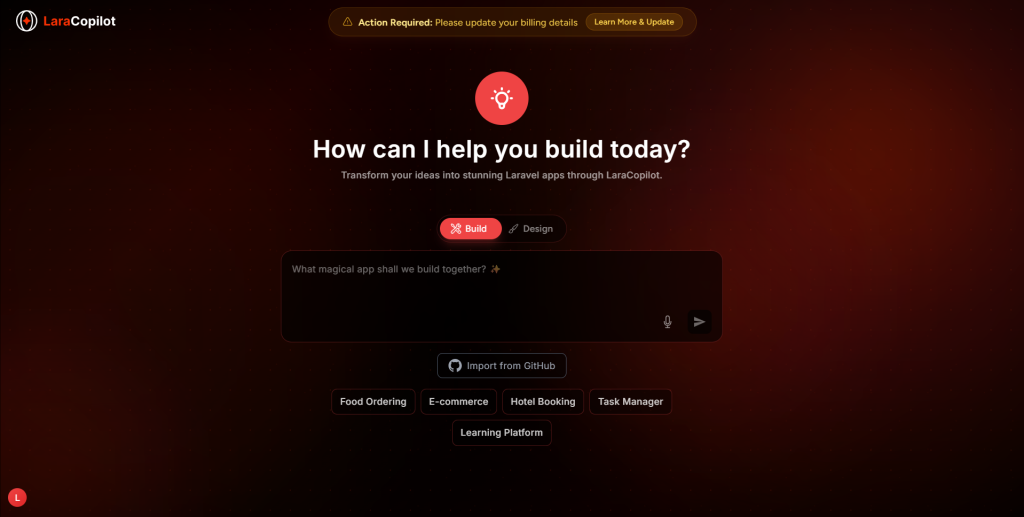
You’ll see the Import from GitHub button right on the LaraCopilot home screen. Click it, connect your repo, and you’re in. LaraCopilot will orient itself to your project and you can start giving it instructions straight away.

That’s it. No long setup. No configuration files. No onboarding checklist.

Just your existing project now with LaraCopilot working inside it.

Already have a Laravel project sitting on GitHub? This is your sign to try it.

LaraCopilot Build & Design Mode — Now Live

Let us be honest about something.

Most people who want to build a Laravel app don’t start with a database schema. They start with a feeling. A problem they’ve seen. A product they wish existed. And then they get stuck the moment a tool asks them to “describe your architecture.”

That gap between the idea in your head and the technical input a tool needs is exactly what we were trying to close.

So we built Build Mode and Design Mode.

Start From Where You Are, Not Where the Tool Expects You to Be

Here’s the simplest way to explain the difference.

If you know what the app should do — use Build Mode.

Type something like “I want a hotel booking system where users can search by date, pick a room, and pay online.” LaraCopilot takes that and starts building the Laravel backend — the logic, the database structure, the routes. You don’t need to explain how any of it works technically. You just need to know what it should do.

If you know what the app should look like — use Design Mode.

Maybe you have a Figma file. Maybe you’ve seen a product you like and want something similar. Maybe you just know the layout feels wrong and you want to fix it before writing a single line of logic. Design Mode lets you start there with the visual layer and LaraCopilot figures out how to connect it to a working Laravel app underneath.

That’s it. Two entry points. Same destination.

Why We Built This

We kept hearing two very different complaints from two very different types of users.

Founders kept saying: “I know what I want but I don’t know how to describe it technically.”

CTOs kept saying: “I know how it works technically but I need to see it before I can explain it to my team.”

Both problems are real. And they’re basically opposites. One mode was never going to fix both.

So now there are two. And you just pick the one that matches how your brain is working that day.

Quick-Start Options Help Too

If you’re not sure where to begin, you’ll notice five prompts already waiting for you — Food Ordering, E-commerce, Hotel Booking, Task Manager, Learning Platform. These aren’t just examples. They pre-load context so LaraCopilot already understands the type of app you’re building before you say anything. Your first result comes out closer to what you actually need.

Go Try It

Both modes are live right now. Open LaraCopilot, look for the toggle, and just pick whichever one feels right.

You don’t need to fully understand it before you start. That’s kind of the point.

One-Click Laravel Cloud Deployment in Laracopilot

Laracopilot now lets you deploy your app in one click using Laravel Cloud.

No setup.

No manual steps.

No switching tools.

Just build and go live.

What’s New

You can now deploy your Laravel application directly from Laracopilot.

  • One-click deployment
  • No server configuration
  • No manual commands

From code → live app in seconds.

Why This Matters

Deployment is where most builders slow down.

You finish building…

Then spend hours figuring out:

  • servers
  • configs
  • deployment steps

It breaks your flow.

This update removes that gap.

Built for Speed

With this integration, deployment becomes part of your build process.

You don’t need to:

  • leave your workspace
  • configure environments manually
  • depend on complex DevOps steps

You build → you click → it’s live.

No More Context Switching

Earlier, the workflow looked like this:

Build in one place

Deploy in another

Debug somewhere else

Now it’s all in one flow.

Everything happens inside Laracopilot.

From Idea to Live App

This feature is especially useful when you want to:

  • test ideas quickly
  • launch MVPs faster
  • ship without delay

You don’t get stuck between “it works locally” and “it’s live”.

Who This Is For

  • Developers who want faster deployments
  • Founders shipping MVPs
  • Indie builders moving quickly
  • Small teams avoiding DevOps complexity

If deployment slows you down, this fixes it.

What You Can Do Next

  • Build your Laravel app in Laracopilot
  • Click deploy
  • See it live instantly

No extra steps.

Ready to Code Smarter with Laravel?

Meet LaraCopilot — your AI full-stack assistant built for Laravel developers.
Skip the boilerplate, build faster, and focus on what matters: problem solving.

Try LaraCopilot Now

Closing

Most tools help you build.

Very few help you ship.

With one-click deployment, Laracopilot helps you do both without friction.