The best free AI app builders in 2026 are Lovable, Bolt.new, Replit, and LaraCopilot, but what their free tiers actually generate varies significantly. Most give you a UI demo or a constrained browser environment. LaraCopilot’s free credits generate real Laravel backend code you can deploy. Here is the honest breakdown of each.
Most “free AI app builder” searches end in frustration. You sign up, use the credits, get an interface that looks impressive, then spend two days trying to get it to connect to a real database. The free tier worked exactly as advertised: it generated a demo. You wanted a starting point for a real app.
This review focuses on a single question for each tool: what does the free tier actually give you that you can ship?
Key Takeaways
- “Free” in AI app builders means three different things: free UI demo credits, free token budgets for a constrained environment, and free credits that generate deployable backend code.
- Lovable’s free tier generates React frontends with basic Supabase integration. Good for UI prototypes, limited for complex backend logic.
- Bolt.new’s free tier generates full-stack Node.js in a browser tab. No persistent database connection. Strong for demos, not for production.
- Replit’s free plan gives you a cloud IDE; AI code generation features are largely behind the paid tier as of 2026.
- LaraCopilot’s free credits generate framework-aware Laravel output: Eloquent models, Policies, resource controllers, and migrations. The output runs in production.
What “Free” Actually Means for AI App Builders
Free Tier vs. Free Trial vs. Genuinely Free
Before comparing tools, it helps to understand what “free” is actually offering:
Free trial credits: A one-time token or generation budget that expires. You get a taste, then hit a paywall. Most AI builders use this model.
Free tier with a ceiling: A permanent free plan that remains usable but caps your generations per day or month. The free plan does not expire, but it limits what you can build before needing to upgrade.
Genuinely unlimited free: Rare in AI tooling. Most providers cannot sustain compute costs on an unlimited free model.
The practical difference matters. If you are an indie hacker building a side project on a budget, a free tier that gives you ten generations a day and never expires is more valuable than a free trial that gives you 100 generations once and then asks for a credit card.
Output Question: UI Demo or Deployable Code?
The more important question than how much free usage you get is what that free usage produces.
An AI builder that generates a beautiful React interface in three free generations and a tool that generates a working Laravel backend with auth, models, and migrations in three free generations are not comparable, even if the credit count is identical.
Understanding how emergent AI capabilities differ across purpose-built app builders helps set the right expectations before you invest in a free tier.
Rafael is an indie hacker based in São Paulo, building a B2B prospecting tool for US sales teams. In February 2026, he signed up for three different “free” AI app builders in a single afternoon. Two hours later he had three interfaces that looked polished and ran in demo environments. None of them connected to a real database. None had auth flows he could actually configure. He had used his free credits on screenshots, not software. He tried LaraCopilot’s free tier that evening. One prompt generated a contacts API with Eloquent models, a Policy class, resource routes, and a migration he ran with php artisan migrate. He had a working API endpoint before midnight.
4 Best Free AI App Builders Compared
Lovable (Free Tier)’
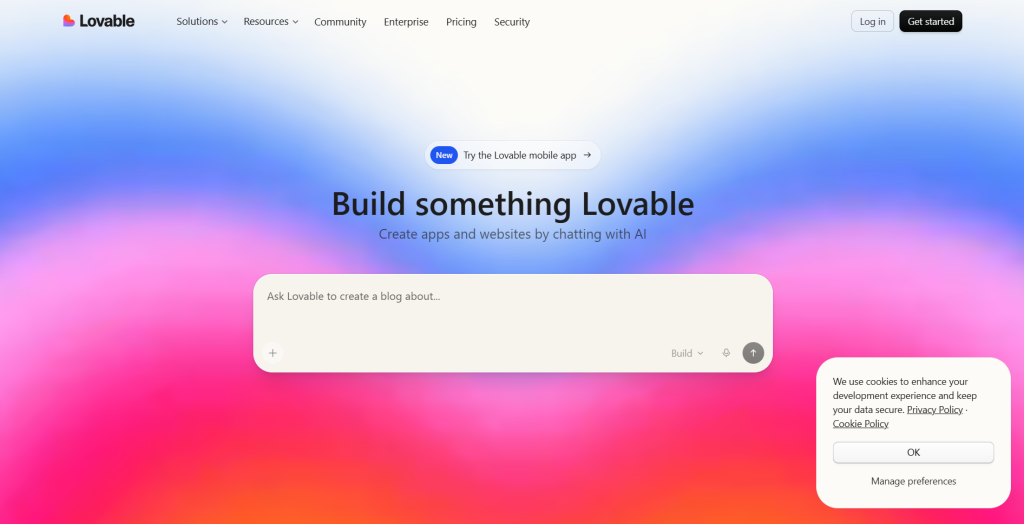
What Lovable is: A React and TypeScript AI app builder that generates frontends connected to Supabase. Formerly known as GPT Engineer, it relaunched as Lovable and gained significant traction for its clean UI output and iterative generation model.
What the free tier gives you: Lovable’s free plan includes a limited number of messages per day. Each message is a generation or revision. You describe a feature or change and the AI updates the app. The output is a React frontend with Supabase handling the database layer. For simple CRUD applications (a todo app, a contact form, a basic dashboard), the free tier covers a useful amount of ground.
What the free tier does not give you: Lovable is frontend-first. Complex server-side logic, custom auth flows with role-based permissions, or multi-table database relationships with business rules in the backend are not its strength at any tier. On the free plan, you exhaust your daily messages quickly when iterating on a non-trivial feature.
Free tier verdict: Excellent for prototyping a React UI with basic Supabase CRUD. Hits a ceiling fast on any app that needs real backend logic. The Supabase integration is convenient but limited to what Supabase’s Row Level Security can handle without custom server-side code.
Best free for: Indie hackers who want a fast, visual frontend prototype before deciding whether to build out the backend. Not the tool for anyone whose core product is the backend.
Bolt.new (Free Tier)
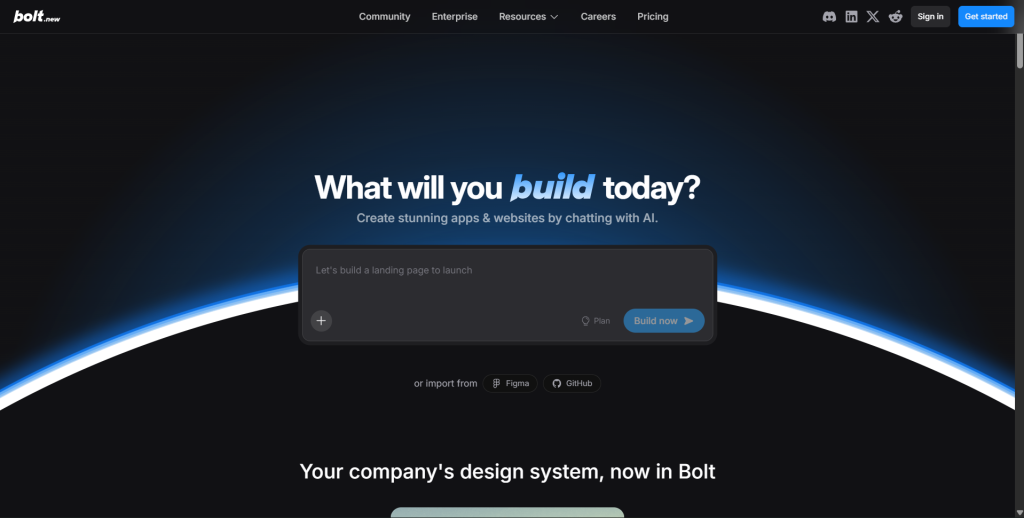
What Bolt.new is: A browser-based AI app builder from StackBlitz that runs a full Node.js environment in WebContainers. You describe an app, the AI generates it, and it runs live in your browser tab with no installation required.
What the free tier gives you: Bolt.new’s free tier provides a token budget for each session. Within that budget, you generate a full-stack JavaScript application running in-browser. The output typically includes a React or Svelte frontend and an Express or Node.js backend, all running in WebContainers. The UI is usually impressive. The zero-setup experience is genuinely one of the best in the category.
What the free tier does not give you: WebContainers run in the browser, not on a server. There is no persistent MySQL or PostgreSQL database in the free environment. Your data lives in SQLite in-memory or a JSON file. When the tab closes, the state resets. Deploying the generated app to a real server requires extracting it from WebContainers and reconfiguring the data layer, which typically takes more time than the generation itself. The free token budget is also moderate; complex applications exhaust it before reaching a complete feature.
Free tier verdict: The best “wow” experience of any free AI builder. The worst gap between demo and deployable of any tool on this list. Bolt.new’s free tier shows you what your app could look like. It does not show you what it would take to make it run in production.
Sophie is a developer in Bristol who used Bolt.new’s free tier to prototype a SaaS tool for freelance project tracking. The prototype was impressive enough that she showed it to a potential investor during a call in January 2026. The investor asked for a link to try it. Sophie had to explain that it was running in a browser tab on her laptop. The session had expired. The investor passed, citing the demo-only state of the product. Sophie rebuilt the backend in Laravel using LaraCopilot and had a real staging URL two weeks later.
Start Free on LaraCopilot and generate a backend that actually runs, not a demo that expires.
Replit (Free Tier)
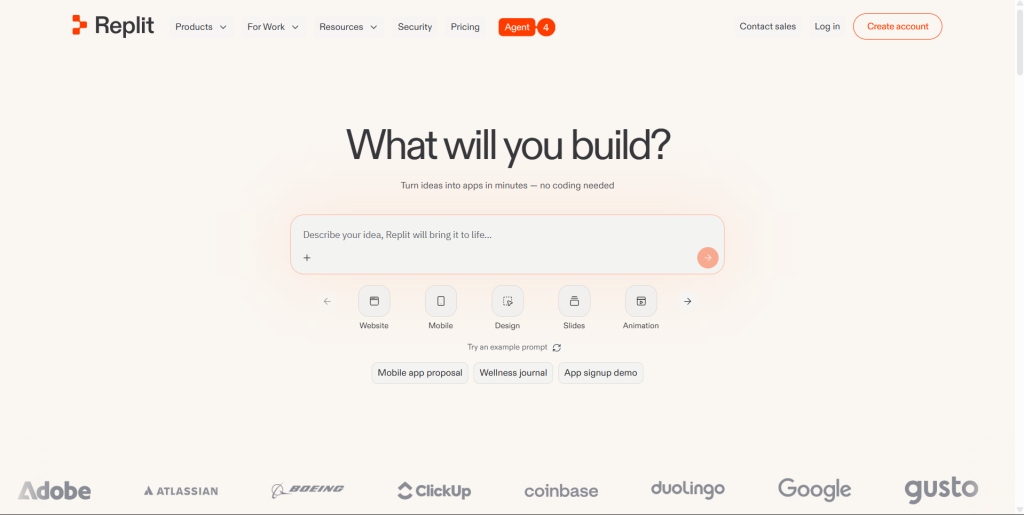
What Replit is: A cloud-based IDE and development environment. Replit allows you to write, run, and deploy code in the browser across dozens of languages. It has a separate AI feature layer (Replit AI) that provides code completion, explanation, and generation within the editor.
What the free tier gives you: Replit’s free plan gives you access to the IDE and the ability to run projects. Community-published templates let you start from a working codebase. The free plan includes basic AI assistance (limited completions and suggestions), storage, and the ability to run background processes.
What the free tier does not give you: Full AI code generation capabilities in Replit are part of the paid Replit Core subscription as of 2026. The free tier’s AI is closer to a lightweight code completion tool than a full generation system. You can write and run code with AI assistance, but the AI generation depth that competes with Lovable or Bolt.new requires the paid plan.
Free tier verdict: Replit is better described as a free cloud IDE with AI enhancement than a free AI app builder. For learning, small experiments, and running code without local setup, the free tier is genuinely useful. For AI-generated app scaffolding comparable to the other tools in this list, the free tier falls short.
Best free for: Developers who want a cloud development environment and do not need deep AI generation. Strong for education, learning, and code experiments. Weaker as a builder for shipping production apps.
LaraCopilot (Free Credits)
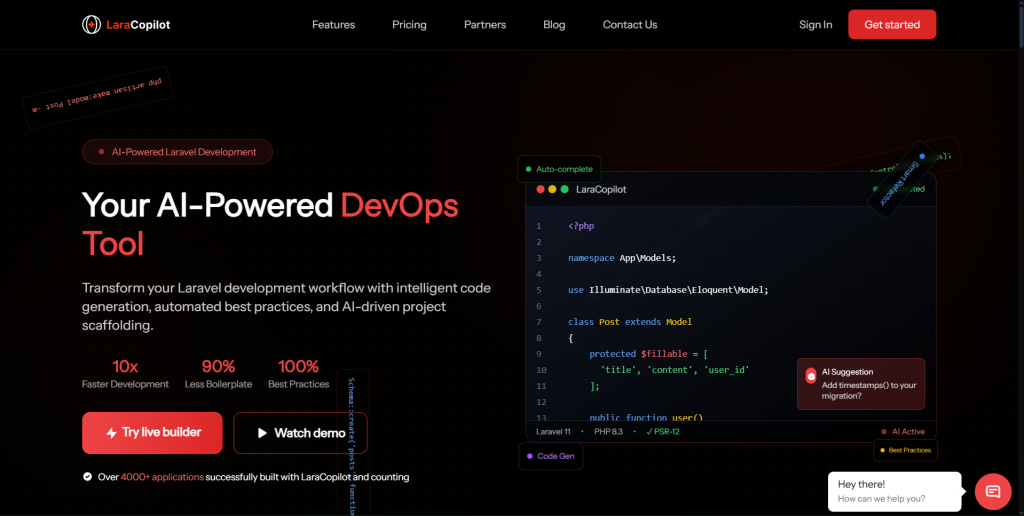
What LaraCopilot is: A Laravel-specific AI tool that generates framework-aware backend code. It understands your project context: your existing models, your route structure, your Eloquent relationships. The output it produces is not boilerplate that happens to mention Laravel. It is code written to fit your actual codebase.
What the free credits give you: LaraCopilot’s free tier includes credits that run real generation sessions. Within those credits, you can scaffold a meaningful slice of a real backend: a model with relationships, a Policy, a resource controller, the corresponding migration, and route registration. The output runs on first php artisan migrate.
Here is what a single free credit session can generate:
// Generated in one LaraCopilot session on free credits:
// Contact.php: Eloquent model with company relationship and activity log
// ContactPolicy.php: admin full access, sales_rep own records
// ContactController.php: resource controller with FormRequest validation
// StoreContactRequest.php: validation rules
// 2026_05_07_000001_create_contacts_table.php: migration with indexes
// AuthServiceProvider.php: updated with policy registration
That is not a UI prototype. That is a working API slice you can php artisan migrate and immediately hit with a REST client.
What makes LaraCopilot’s free tier different: Every other tool in this list generates frontend components or demo-grade backend code as its free output. LaraCopilot generates backend code written to Laravel’s actual conventions. A free session gives you something you can push to a repository, run in staging, and build on.
Free tier verdict: The highest-value free tier for any developer whose app needs a real backend. The credits are not unlimited, but what they buy is different in category from the credits on other tools.
Best free for: Any developer building a Laravel application who wants to see what framework-aware AI generation actually produces before committing to a subscription.
Tom is a developer in Sydney who ran a free tier comparison in March 2026 as part of evaluating tools for a client project. He gave the same contacts API spec to Lovable, Bolt.new, and LaraCopilot using each tool’s free tier. Lovable generated a React table component with Supabase. Bolt.new generated an Express route file running in WebContainers with no database. LaraCopilot generated an Eloquent model, a Policy, a FormRequest, a resource controller, and a migration. Tom had the LaraCopilot output running in staging by 5pm. The Lovable and Bolt.new outputs required two additional days of work each before they could be deployed.
Comparison: Free Tiers Side by Side
| Tool | Free Tier Type | What It Generates | Persistent DB | Production-Ready Output | Best Free For |
|---|---|---|---|---|---|
| Lovable | Daily message limit | React UI + Supabase CRUD | Via Supabase | Partial (frontend solid, backend limited) | UI prototypes, visual demos |
| Bolt.new | Token budget per session | Full-stack Node.js in WebContainers | No (in-browser only) | No (demo-grade, not deployable as-is) | Client demos, UI validation |
| Replit | Free IDE + limited AI | Code editor + basic AI completion | Yes (with setup) | Partial (IDE only; full AI = paid) | Learning, code experiments |
| LaraCopilot | Credit-based sessions | Laravel models, Policies, controllers, migrations | Yes (MySQL/PostgreSQL) | Yes (runs on first migrate) | Backend-first apps, real scaffolds |
What Happens When Your Free Credits Run Out
Free credits are a starting point, not a full product. Understanding what comes next matters as much as the free tier itself.
Lovable: The paid plan unlocks more daily messages and removes the per-day ceiling. The generated output quality does not change; you get more of the same.
Bolt.new: The paid plan increases your token budget substantially and removes session length limits. If WebContainers fits your use case, the paid plan makes Bolt.new significantly more productive.
Replit: The Replit Core subscription unlocks full AI generation, larger storage, and always-on deployments. It is a meaningful step up from the free tier.
LaraCopilot: The paid subscription unlocks unlimited generation sessions with full project context awareness. The AI has access to your entire codebase: all existing models, routes, relationships, and policy registrations. Output quality on the paid tier is higher because the context depth is greater.
For developers building on a bootstrap budget, the practical path is: use the free tier to validate that the tool generates code worth using, then upgrade once you know the output quality matches your stack.
Decision Framework: Which Free Tier Should You Start With?
Start with LaraCopilot free credits if:
- You are building a PHP/Laravel backend
- You want to verify that AI generation produces real, deployable code before paying
- Your app needs database relationships, auth policies, or REST API output
- You are an experienced developer who will know good Laravel output when you see it
Start with Lovable free tier if:
- Your priority is a fast, visual React frontend
- You are using Supabase and want to skip backend setup entirely for a simple CRUD app
- You want to prototype a UI for stakeholder feedback before building anything
Start with Bolt.new free tier if:
- You need a live demo in your browser today with zero setup
- You are validating a concept with a client or co-founder and do not need the code to be deployable
- Your stack is Node.js and you want to explore what AI-generated JavaScript looks like
Start with Replit free if:
- You want a cloud IDE for learning or experimentation
- You are writing and running code manually and want lightweight AI assistance
- You do not need deep AI code generation on day one
According to the Stack Overflow Developer Survey 2025, 67% of developers now use AI coding tools weekly. The free tier of any tool is your lowest-risk test of whether that tool belongs in that 67% for you.
Ready to Code Smarter with Laravel?
Meet LaraCopilot — your AI full-stack assistant built for Laravel developers.
Skip the boilerplate, build faster, and focus on what matters: problem solving.
Which Free AI App Builder Is Worth Your Time
Free AI app builders in 2026 are not all offering the same thing for free. The difference is not in how many credits you get. It is in what those credits actually produce.
Lovable’s free tier is the fastest path to a React prototype. Bolt.new’s free tier produces the most impressive live demo. Replit’s free tier gives you a capable cloud IDE. None of them generate a deployable backend on the free tier without significant additional work.
LaraCopilot’s free credits are the exception. The output runs. The migrations work. The Policies are registered. You can push the generated code to a repository today.
If you are a developer who has burned free credits on AI builders that produced demos and not deployable code, LaraCopilot’s free tier is the one worth testing next.
Start Free on LaraCopilot and run your first real backend scaffold today.