To build a marketplace app in 2026, you need five things wired together: a two-sided role system (buyer and seller), a listings model, search and filters, a reviews and trust layer, and Stripe Connect for split payouts. AI builders like LaraCopilot now generate that entire backend from a single prompt, cutting a 3 to 6 month marketplace MVP into roughly two weeks of focused work.
That is the short answer. The longer answer is the one most indie builders need, because almost every “how to build a marketplace” article on the internet skips the parts that actually kill marketplaces: the role split, the payouts, and the cold start.
Last winter, an indie developer named Priya shipped a beautiful peer-to-peer rental listing page in three weekends. It looked like a small Airbnb. Then she opened the Stripe Connect documentation, read about KYC, payouts, application fees, and capability requirements, and quietly shelved the project for four months. Her marketplace did not fail because the idea was bad. It failed because the backend complexity that turns a “listings page” into a real marketplace is genuinely hard, and most tutorials stop right before that point.
This guide picks up where those tutorials drop off. We will walk through how to create a marketplace app end-to-end in 2026, what each backend piece actually does, which marketplace archetype matches your idea, and how an AI-native Laravel builder like LaraCopilot generates the whole thing from one prompt.
Key Takeaways
- Every marketplace app needs five backend pieces: two-sided roles, listings, search, reviews, and split payouts. Skip any of them and the product is incomplete.
- Stripe Connect (Express or Custom) is the standard for marketplace payouts in 2026, and it is the single hardest piece to wire up manually.
- Marketplace archetypes (rental, service, freelance, product) each need different transaction flows. Choose one before you write a line of code.
- AI-assisted Laravel builders compress a 3 to 6 month marketplace MVP into 2 to 3 weeks by scaffolding roles, listings, search, reviews, and Stripe Connect in one generation pass.
- Roughly 70% of marketplaces fail at the liquidity stage, not the build stage. Plan your cold-start strategy before you build a marketplace app.
Why Marketplace Apps Are Harder Than They Look
A marketplace is not an e-commerce store with extra sellers. It is a role-split application with a payments engine in the middle, and that architectural difference is why most “build a marketplace” tutorials fall short.
In a standard e-commerce app, one party (the store owner) lists products and collects payment. Easy. In a marketplace, two parties transact through your platform: the buyer pays, the seller delivers, and you sit in the middle taking a fee. That middle layer touches identity, payouts, taxes, reviews, disputes, and trust signals. If any one of them breaks, the marketplace breaks.
Backend Most Tutorials Skip
Open any “10 steps to build a marketplace” post and count how many lines they spend on:
- Two-sided authentication and role permissions
- Seller KYC verification for payouts
- Stripe Connect onboarding flows
- Marketplace fee calculation at charge time
- Refunds that respect commission already paid out
- 1099-K tax reporting thresholds in the US
The honest answer is usually zero. Tutorials stop at “users can list items,” and call it a marketplace. That is the difference between a working product and a portfolio piece.
Why No-Code Builders Stall on Marketplaces
No-code marketplace builders (Sharetribe, Arcadier, Bubble) handle the front end well. They fall apart in three places: custom transaction flows, true ownership of the codebase, and Stripe Connect customization beyond the defaults.
If your marketplace is a near-clone of Airbnb or Etsy, no-code can ship faster. The moment you add a custom booking flow, a non-standard commission model, or vertical-specific data, you are fighting the platform. Indie hackers who started on no-code marketplaces and then needed to migrate to code report the migration alone takes 2 to 4 months. You are better off owning the code from day one if you suspect any customization in your roadmap.
5 Backend Pieces Every Marketplace App Needs
These five pieces are the analytical backbone of marketplace app development. Every successful marketplace app in 2026 implements all five. Most failed marketplaces are missing two or three.
1. Two-Sided Role System (Buyer + Seller)
A marketplace has two user types, and they often coexist in one account. Someone who rents out their camera gear on a rental marketplace may also rent gear from other users. The data model needs to support that.
Concretely, you need:
- A
userstable with role flags (is_buyer,is_seller, or a many-to-manyuser_rolestable) - Role-specific dashboards with different navigation, permissions, and onboarding steps
- A seller verification flow (identity, payout details, optional business documents)
- Permission rules so a seller cannot edit another seller’s listings, refund their own purchases, or game the review system
Most boilerplates ship a single-role auth scaffold. Marketplaces need a two-role scaffold, which is more work than it sounds.
2. Listings Model
Listings are the heart of the product. A listing can be a rental property, a service offer, a freelance gig, a physical item, or a piece of digital content. Despite the variety, the underlying model is similar.
A solid listings table tracks:
- Owner (the seller user ID)
- Status states:
draft,pending_review,live,paused,archived - Title, description, photos (with image processing and CDN)
- Categories, tags, and search keywords
- Price model (fixed, hourly, daily, custom quote)
- Location data for geographic marketplaces (lat, lng, address, geohash)
- Availability windows for booking-based marketplaces
The status field is load-bearing. Marketplaces need a review step between “seller creates” and “buyer sees” so spam, low-quality, or non-compliant listings never reach the buyer side.
3. Search and Discovery
Marketplaces live or die on search. If a buyer cannot find what they want in 30 seconds, they leave and never come back. That is the second-hardest backend piece after payouts.
Effective marketplace search includes:
- Faceted filters: price range, category, rating, location radius
- Geolocation search (“near me,” radius-based, map view)
- Sort by relevance, price, rating, newness, distance
- Pagination that does not lose state on filter change
- For 2026, AI-assisted natural language search. A buyer types “plumber under $80 available Saturday afternoon” and the system parses category, price ceiling, and availability window from one sentence.
In practice this usually means a Laravel app paired with Meilisearch, Typesense, or Algolia for the search layer, plus PostGIS or a geohash strategy for geographic queries.
4. Reviews and Trust
Reviews are the trust engine of every marketplace. Without them, buyers have no signal that a seller is reliable, and sellers have no incentive to behave well.
A marketplace reviews system needs:
- Two-way reviews (buyer reviews seller, seller reviews buyer)
- Review eligibility tied to completed transactions only, never to mere account creation
- A blind double-review window so neither party sees the other’s review until both have submitted (or 14 days have passed)
- Reporting and dispute escalation
- A visible reputation score on every profile
Skip this and your marketplace becomes a graveyard within six months. Trust is what separates a marketplace from a classifieds board.
5. Payments and Payouts (Stripe Connect)
This is the single hardest piece of marketplace app development, and the one most articles dodge.
When a buyer pays $100 on your marketplace, you cannot just collect $100 into your own Stripe account. The money belongs to the seller. You have to:
- Onboard sellers as connected accounts on Stripe Connect (Express, Custom, or Standard)
- Verify their identity and payout details (KYC) before they can receive money
- Charge the buyer, split the funds at charge time, route the seller’s share to their connected account, and keep your platform fee
- Handle refunds correctly: refunding the buyer must also claw back the seller’s portion and your fee
- Issue 1099-K tax forms in the US for sellers above the reporting threshold
- Handle disputes, chargebacks, and platform liability when a transaction goes wrong
A typical indie developer spends 4 to 8 weeks getting Stripe Connect right by hand. An AI builder that ships a Stripe Connect integration as part of its marketplace template removes that entire chunk of work.
Choose Your Marketplace Type Before You Build
The five pieces above apply to every marketplace, but the transaction flow is different for every archetype. Pick yours before you generate code, because the rest of the build hangs on it.
| Marketplace Type | Real-World Analogue | Monetization | Backend Hotspot |
|---|---|---|---|
| Rental / Booking | Airbnb, Turo, Peerspace | 8 to 15% service + host fee | Calendar, double-booking prevention |
| Service Marketplace | Thumbtack, TaskRabhit, Upwork | Lead fee or 10 to 20% | Quote flow, scheduling, escrow |
| Freelance Marketplace | Fiverr, Upwork, Toptal | 10 to 20% + plan fees | Milestones, escrow release |
| Product Marketplace | Etsy, Reverb, StockX | 5 to 15% sale + listing fee | Multi-vendor inventory, shipping |
| Rental of Goods | Fat Llama, ShareGrid | Per-rental + insurance | Deposits, condition, returns |
| Niche Vertical | Houzz, Chairish, Reverb | Subscription + commission | Vertical attributes, curation |
Rental Marketplaces (Airbnb-Style)
Rental marketplaces revolve around a calendar. Two buyers cannot book the same unit on the same night, and that constraint shapes the entire data model. You need an availability table, a holds/reservation state, and a confirmation flow that captures payment when the host approves (or instantly, depending on listing settings).
Service Marketplaces (Thumbtack-Style)
Service marketplaces add a quote step before the booking. The buyer requests work, sellers send quotes, the buyer picks one, and only then does payment flow. Escrow is common: the platform holds funds until the service is delivered.
Freelance Marketplaces (Fiverr-Style)
Freelance marketplaces center on milestones. A $2,000 project might split into four $500 milestones. The buyer funds an escrow, the freelancer completes each milestone, the buyer approves, and the platform releases that milestone’s funds (minus your commission). This is harder than booking because partial failure is common and dispute volume is higher.
If your marketplace is product-only with no seller-to-seller variability, a single-vendor e-commerce app is probably the right architecture, not a multi-sided marketplace. Choose accordingly.
How to Build a Marketplace App with AI in 2026 (Step by Step)
Here is the practical workflow. This is how indie developers ship marketplace MVPs in 2026, end to end.
Step 1: Describe Your Marketplace in One Paragraph
Before touching code, write a tight description. Not a pitch deck. One paragraph that names the buyer, the seller, the asset, the transaction, the fee, and the geography.
Example:
“A marketplace where independent photographers rent their gear (cameras, lenses, lighting) to other photographers in the same city. The buyer (renter) books gear for a date range, pays the rental price plus a security deposit. The seller (gear owner) accepts or declines within 24 hours. Platform takes 10% of the rental and holds the deposit in escrow until the gear is returned in good condition.”
That paragraph contains roles, listing type, transaction flow, monetization, and dispute model. It is the seed for every downstream decision.
Step 2: Generate the Backend with LaraCopilot
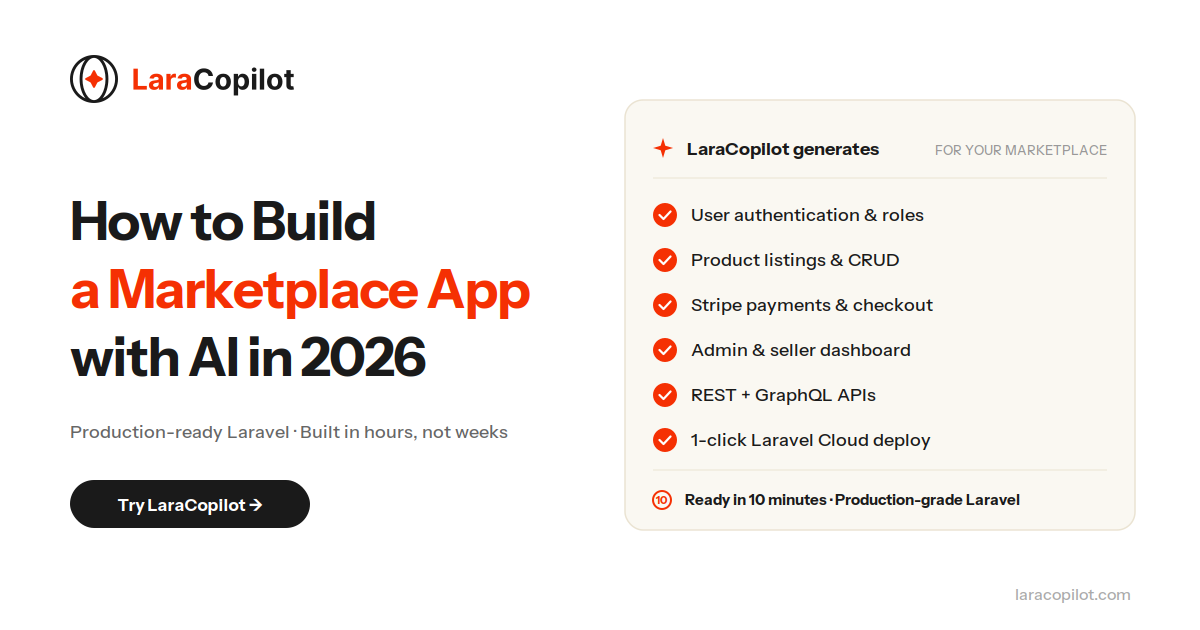
Paste that paragraph into LaraCopilot’s prompt window and add: “Generate the Laravel backend including buyer/seller roles, listings, search with filters, two-way reviews, and Stripe Connect for split payouts.”
The output, in roughly 4 to 8 minutes, is a working Laravel app:
userstable with role flags and seller KYC fieldslistingstable with photos, geolocation, availability windowsbookingstable with reservation states and double-booking preventionreviewstable with double-blind window logic- Stripe Connect onboarding controller, webhook handlers, and payout split logic
- Admin panel to review listings, manage disputes, and view platform fees collected
- A responsive frontend with separate buyer and seller dashboards
Want to see this run end-to-end on your own idea? Build Your Marketplace Today →
Step 3: Review the Generated Output
Open the project in the browser-based IDE. You should see, at minimum, these files:
app/Models/
 User.php (with HasRoles trait)
 Listing.php
 Booking.php
 Review.php
 StripeAccount.php

app/Http/Controllers/
 Buyer/
 BookingController.php
 SearchController.php
 Seller/
 ListingController.php
 PayoutController.php
 Marketplace/
 ReviewController.php
 StripeWebhookController.php
Migrate the database, seed a few test listings, and run through the flow as a buyer and again as a seller. The double-blind review window, the booking holds, and the Stripe Connect onboarding should all work out of the box.
Step 4: Wire Up Stripe Connect for Payouts
LaraCopilot ships the Stripe Connect scaffold. You still need to:
- Create a Stripe account and enable Connect (Express recommended for indie marketplaces)
- Add your live keys to
.env - Configure webhook signing secrets
- Test the full flow with Stripe test mode: seller onboards, buyer books, platform fee is collected, seller payout is scheduled
- Verify refund logic by issuing a test refund and confirming the seller’s payout is correctly clawed back
This step takes a day or two even with scaffolding, because Stripe Connect has real-world compliance edges that no scaffolder can guess (your platform’s risk tier, your country’s payout rules, your fee model).
Step 5: Solve the Cold-Start (Liquidity) Problem
This is where most marketplaces actually die, and it is rarely a build problem. Roughly 70% of marketplace failures happen at the liquidity stage, not the technical build.
If you decide to build a marketplace app in 2026, the launch problem is almost never the code. It is liquidity. Practical cold-start tactics that work in 2026:
- Start one-sided: Recruit sellers manually (10 to 50 of them) before buyers ever see the site. A marketplace with no supply is a 404.
- Pick a tight geographic or vertical niche: “Camera rental in Brooklyn” beats “global gear marketplace.” Liquidity is local.
- Concierge the early transactions: Manually match buyer and seller for the first 30 to 100 deals. Learn the friction. Fix it.
- Subsidize early sellers: Waive your commission for the first 90 days. You are paying for liquidity, not revenue.
Step 6: Launch to a Tight Niche, Then Expand
When a freelance designer named Marcus launched his peer-to-peer 3D printer marketplace in February 2026, he did not announce on Product Hunt. He posted in three local 3D-printing Discord servers, recruited 22 sellers personally over two weeks, and only opened buyer signups once 40 printers were listed. Six weeks in, he was processing roughly $4,200 a week in rentals and taking a 12% platform fee. He did not solve the liquidity problem with marketing. He solved it with a tight enough niche that 40 listings looked like a real marketplace.
What LaraCopilot Generates for a Marketplace App
When you describe a marketplace and ask for a Laravel backend, the AI marketplace builder workflow ships:
- Auth and roles: Two-sided user model with separate buyer and seller dashboards, plus role-based middleware
- Listings: Polymorphic listings model with photo upload, geolocation, status workflow, and admin review
- Search: Faceted search with filters, sort, and geographic radius (with Meilisearch or Typesense integration as an option)
- Bookings or orders: Transaction lifecycle appropriate to your archetype (calendar bookings for rentals, milestone-based for freelance, basket for product marketplaces)
- Reviews: Two-way review system with completion-gated eligibility and a double-blind window
- Stripe Connect: Onboarding, KYC capability requirements, charges with platform fee, webhook handlers, refund logic, payout scheduling
- Admin panel: Listing review queue, dispute management, fee report, user moderation
Every file is production Laravel code, lints under Laravel Pint, and exports cleanly to a GitHub repository you own. No abstraction wrapper, no proprietary lock-in.
If you have already shipped a paid app and want to layer marketplace mechanics on top, the same scaffold applies. You are adding a second user role and a Connect layer to an existing app, not rebuilding.
Common Mistakes Indie Builders Make on Their First Marketplace
The marketplaces that fail tend to fail in predictable ways. Watch for these.
- Launching with both sides at zero. Recruit one side manually first. Sellers, usually.
- Going too broad on geography or vertical. “Photographers in Brooklyn” beats “creatives worldwide” every time at launch.
- Skipping the listings review step. Spam listings will appear within 48 hours of opening signups. The status workflow exists for a reason.
- Hand-rolling Stripe Connect. It is a 4-to-8-week side quest that will burn most of your motivation. Use a scaffold.
- No dispute path. When the first contested transaction lands (and it will, by week 3), having no playbook costs you both users and your weekend.
- Charging too high a commission too soon. Twenty percent on a pre-liquid marketplace kills supply. Start at 5 to 10% and raise it once liquidity is real.
- Treating reviews as optional. Reviews are the moat. Marketplaces without working reviews collapse to classifieds.
Marketplaces Are a Backend Problem. AI Just Solved Most of It.
In 2026, the question of how to create a marketplace app is no longer about whether you can build the backend. AI builders ship the role system, the listings model, the search, the reviews, and Stripe Connect in one prompt. The real questions are:
- Which marketplace archetype matches your idea (rental, service, freelance, product)?
- How tight can you make your launch niche to solve cold-start liquidity?
- Are you willing to manually recruit sellers for the first 30 to 90 days?
Answer those, then let the AI builder generate the backend in an afternoon. You will spend your time where it actually matters: selecting the niche, recruiting the first cohort, and shaping the dispute and review experience that turns a listings page into a real marketplace.
The 6-month marketplace MVP is dead. In 2026, you can build a marketplace app with AI in two weeks, and you can spend the next six months actually growing it.
Build Your Marketplace Today → Start with LaraCopilot