Laravel Project Estimation with AI: Agency Playbook

If you’ve run a Laravel agency long enough, you’ve experienced this cycle more than once.

A client comes in with a clear idea. You review the requirements, discuss features, and put together a timeline. The estimate looks reasonable, the scope feels manageable, and the project moves forward with confidence.

But somewhere along the way, things start to shift.

New edge cases appear. Requirements evolve. Small features take longer than expected. And before you realize it, the project has gone beyond the original estimate.

This doesn’t happen because your team lacks experience. It happens because estimation, by its nature, is based on incomplete information.

Why are Laravel project estimates often inaccurate?

Most Laravel project estimates are built on assumptions rather than actual implementation. You’re trying to predict effort based on requirements, without seeing how those requirements translate into code.

Even for experienced developers, this introduces uncertainty. A feature that seems straightforward in discussion can involve multiple layers of logic once development begins. Validation rules, edge cases, database relationships, and integrations all add complexity that isn’t always visible upfront.

As a result, estimates tend to drift. Not because the team is careless, but because the initial understanding was incomplete.

Why do inaccurate estimates hurt agency margins?

When estimates are off, the impact is immediate and measurable.

Development takes longer than planned, which increases internal costs. Teams spend additional hours refining features, fixing unexpected issues, and managing scope changes. Meanwhile, the client still expects delivery within the agreed timeline.

This creates a mismatch between effort and revenue.

Over time, this pattern eats into margins. Agencies don’t lose money because they fail to win projects. They lose money because projects take longer than expected to deliver.

Why does traditional Laravel project scoping fail?

Traditional scoping relies heavily on abstraction. Teams define features, map out flows, and estimate effort without seeing how those ideas translate into actual code.

This approach works in theory, but it struggles in practice.

Without a concrete implementation, it’s difficult to fully understand the depth of a feature. What looks simple at a high level often becomes more complex when broken down into controllers, validation, database interactions, and user flows.

The gap between planning and execution is where most estimation errors originate.

What should a better estimation process look like?

A more reliable approach to estimation starts with reducing uncertainty.

Instead of estimating based on descriptions alone, you begin with something tangible. A working base that reflects the structure of the application, the relationships between components, and the actual complexity involved.

This allows your team to move from guessing to evaluating.

You’re no longer imagining how the system might work. You’re reviewing how it actually starts to take shape.

How does AI change Laravel project estimation?

This is where the process shifts in a meaningful way.

Instead of estimating first and building later, you reverse the sequence. You generate a base version of the project first, and then estimate the remaining effort.

With tools like LaraCopilot, you can quickly scaffold core elements of a Laravel application, including authentication, APIs, and foundational structure. Within minutes, you have something that represents the project in a more concrete form.

From there, estimation becomes significantly more grounded.

Why does generating project first improve accuracy?

Because it replaces assumptions with visibility.

When you can see the generated structure, you understand the scope more clearly. You can review how many endpoints are required, how validation is handled, and where custom logic needs to be added.

This leads to more precise estimates.

Instead of broad timelines, you can define what is already handled and what still needs to be built. That distinction improves both internal planning and client communication.

How does this affect Laravel development cost estimation?

Clearer scope leads directly to better pricing decisions in Laravel development.

When you understand the actual effort involved, you avoid underestimating projects and absorbing additional work. At the same time, you avoid overestimating and losing competitive deals.

This balance protects your margins.

It also strengthens client trust. When estimates are backed by a visible structure rather than assumptions, they feel more reliable and easier to justify.

What does an AI-first estimation workflow look like?

In practice, the workflow becomes more iterative and grounded.

A client shares their requirements. Instead of immediately writing a detailed scope document, your team generates a base project that reflects those requirements. You then review the generated structure together, identify gaps, and define the remaining work.

This creates a much tighter connection between planning and execution.

Your estimates are no longer based on interpretation alone. They are based on something your team can see, evaluate, and refine.

How does this reduce delivery risk?

Most delivery risk comes from unknowns. When teams don’t fully understand the scope, timelines slip and expectations become harder to manage.

By generating a base project early, many of those unknowns are addressed upfront.

You start with clarity rather than assumptions. That reduces surprises during development and leads to more predictable delivery.

If you want to explore this further, this guide explains how LaraCopilot reduces Laravel delivery risk.

What changes for your team?

When estimation improves, the impact extends beyond planning.

Teams work with greater confidence because they understand the scope more clearly. There is less back-and-forth, fewer unexpected blockers, and a stronger alignment between expectations and execution.

This improves not just timelines, but overall delivery quality.

Does this replace traditional estimation?

Not entirely.

Experience and judgment still play an important role. AI does not replace decision-making. It improves the quality of information those decisions are based on.

Instead of estimating in the dark, you estimate with visibility.

That distinction makes a significant difference.

Ready to Code Smarter with Laravel?

Meet LaraCopilot — your AI full-stack assistant built for Laravel developers.
Skip the boilerplate, build faster, and focus on what matters: problem solving.

Try LaraCopilot Now

Practical Laravel project estimation template you can actually use

Most estimation advice stays theoretical.

This is a simple framework you can apply immediately when scoping a Laravel project, especially if you’re using an AI-assisted approach.

Step 1: Define the core scope (before generation)

Start by listing only what matters at a high level.

Focus on outcomes, not implementation.

  • What is the product? (SaaS, internal tool, API, marketplace)
  • Who are the users?
  • What are the 3–5 core features?

At this stage, avoid over-detailing. You’re setting direction, not writing specifications.

Step 2: Generate the base project

Use your tooling (like LaraCopilot) to generate a working foundation based on the defined scope.

This should include:

  • authentication and user roles
  • basic models and relationships
  • core API or UI structure

Now you have something concrete to review.

Step 3: Break the project into estimation layers

Instead of estimating the whole project as one block, divide it into layers:

1. Already generated (0 effort)

What is already scaffolded and usable?

2. Custom logic (medium effort)

What needs to be extended or customized?

3. Edge cases & integrations (high uncertainty)

Payments, third-party APIs, complex workflows

This separation is critical.

It helps you avoid overestimating simple parts and underestimating complex ones.

Step 4: Assign realistic effort ranges

For each feature, estimate in ranges instead of fixed timelines.

Example:

  • Authentication: Already generated
  • Dashboard: 1–2 days
  • Booking logic: 3–5 days
  • Payment integration: 2–4 days

Ranges give flexibility while still maintaining control.

Step 5: Add buffer where it actually matters

Most teams add a flat buffer across the entire project.

Instead, apply buffer selectively:

  • No buffer on generated parts
  • Small buffer on standard features
  • Higher buffer on integrations and edge cases

This keeps your estimates competitive without exposing you to unnecessary risk.

Step 6: Convert effort into pricing

Once effort is clear, pricing becomes straightforward.

You’re no longer guessing.

You’re pricing based on:

  • visible structure
  • defined features
  • known complexity

This makes your proposal easier to justify to clients.

Step 7: Communicate scope with clarity

Instead of presenting a vague estimate, show:

  • what is already included
  • what will be built
  • where uncertainty exists

This builds trust and reduces future friction.

Why this template works

Because it aligns estimation with reality.

You’re not trying to predict everything upfront. You’re starting with a working base, identifying what’s left, and estimating from there.

That’s the difference between guessing and scoping.

The goal of estimation isn’t to be perfect.

It’s to be predictable.

And the closer your estimate is to actual implementation, the more predictable your delivery becomes.

What does a Laravel project actually cost you? (Quick reality check)

Before we talk about pricing projects for clients, it’s important to understand your own baseline.

If you’re running a Laravel agency, your biggest cost is developer time.

A senior Laravel developer in the US or UK typically costs around $120,000 per year when you include salary, overhead, and benefits. That breaks down to roughly $10,000 per month, which you can see above.

Now think about your current projects.

If one project takes a full month of a developer’s time, that’s your real cost before profit.

Now compare this with an AI-assisted estimation approach

When you start with a generated base instead of building from scratch, your effort shifts.

You’re no longer spending time on:

initial setup

basic scaffolding

repetitive patterns

That means your actual development time reduces.

Example scenario

Let’s say a project traditionally takes:

3–4 weeks of development

With an AI-assisted workflow:

You reduce that to 1.5–2 weeks

What changes?

Your cost per project drops significantly.

Instead of consuming an entire month of developer time, you’re using half of it.

That directly impacts your margins.

Why this matters for estimation

When you estimate based on traditional workflows, your pricing includes inefficiencies.

When you estimate based on AI-assisted workflows, your pricing reflects:

  • actual effort
  • actual speed
  • actual delivery capability

That gives you an advantage.

You can:

  • price competitively
  • deliver faster
  • protect your margins

The strategic shift

Most agencies try to improve estimation by getting better at guessing.

The smarter approach is to reduce the effort required.

Because when effort becomes predictable, estimation becomes easier.

Your pricing is only as accurate as your understanding of effort.

And your understanding of effort improves when you start with something real.

Not assumptions.

Ready to Code Smarter with Laravel?

Meet LaraCopilot — your AI full-stack assistant built for Laravel developers.
Skip the boilerplate, build faster, and focus on what matters: problem solving.

Try LaraCopilot Now

Wrap-up!

Project estimation has always been one of the most challenging aspects of running a Laravel agency. Not because teams lack skill, but because they lack complete information at the start.

AI changes that.

It doesn’t eliminate estimation. It makes it more accurate by reducing uncertainty and grounding decisions in something real.

If you want to improve estimation accuracy and protect your margins:

Scope your Laravel projects with LaraCopilot. Get your agency plan today.

Hire Laravel Developers 2026: CTO’s Complete Guide

Hire Laravel developers used to be straightforward.

You’d open a role.

Interview candidates.

Pick the best one.

Today, it’s different.

You can spend months hiring and still not find the right person. Salaries are rising, expectations are higher, and the best developers already have multiple offers.

It’s not just a hiring problem anymore.

It’s a capacity problem.

Why is hiring Laravel developers getting harder in 2026?

The demand hasn’t slowed down.

If anything, it has increased.

More SaaS products.

More internal tools.

More startups building on Laravel.

But the supply of truly experienced developers hasn’t kept up.

And the gap is not just about coding.

It’s about capability.

Why does “senior Laravel developer” mean something different now?

A few years ago, being senior meant writing clean code and understanding architecture.

That’s no longer enough.

Today, a strong Laravel developer is expected to:

understand systems

review and validate AI-generated code

handle edge cases

make architectural decisions

Because AI tools are now part of the workflow.

And that changes what “good” looks like.

What is causing the Laravel talent shortage?

It’s not just fewer developers.

It’s a mismatch.

There are more developers available than ever.

But fewer who can work effectively in an AI-assisted environment.

Companies are not just hiring for coding skills anymore.

They are hiring for:

judgment

context awareness

ability to work with AI tools

That’s where the real shortage is.

Which tools should Laravel developers know in 2026?

This is no longer optional.

Modern Laravel teams are already using tools like:

Each tool improves a different part of the workflow.

Some help with code generation.

Some with debugging.

Some with full application scaffolding.

A developer who doesn’t understand these tools will move slower.

Not because they lack skill.

But because the workflow has changed.

What should you actually look for when hiring Laravel developers?

Instead of asking:

Can they write code?

You should be asking:

Can they build efficiently?

Because writing everything manually is no longer the benchmark.

You want developers who can:

use AI tools effectively

validate output instead of blindly trusting it

focus on system-level thinking

That’s what drives real productivity.

Why hiring more developers is not always the solution

The default response to slow delivery is simple.

Hire more people.

But that comes with its own problems.

Long hiring cycles.

Higher salaries.

More communication overhead.

And sometimes, no real increase in output.

Because more developers don’t automatically mean faster delivery.

What is the alternative to hiring more Laravel developers?

Improve the output of your existing team.

That’s where the shift is happening.

Instead of scaling headcount, teams are scaling capability.

With AI-assisted development, a smaller team can deliver more.

Not by working harder.

But by removing repetitive work.

How does AI change Laravel team productivity?

AI doesn’t replace developers.

It changes how they work.

Instead of starting from scratch, developers start with a base.

Instead of writing everything, they refine.

Instead of focusing on boilerplate, they focus on logic.

That shift compounds.

Because every feature takes less time.

What does this look like in real numbers?

Let’s compare two scenarios.

In a traditional setup, you might need:

3 developers

to deliver a certain workload

Now consider an AI-assisted setup.

With the right tools, 2 developers can often match or exceed that output.

Not because they’re working more.

But because they’re working differently.

What is the cost difference between hiring and using AI tools?

Hiring a senior Laravel developer in the US or UK can cost anywhere between $80K to $150K per year.

And that’s before onboarding, management, and overhead.

Now compare that with AI tooling.

Even with multiple tools combined, the cost is a fraction of a single hire.

The difference is not small.

It’s significant.

Where does LaraCopilot fit into this strategy?

LaraCopilot focuses on one critical part of the workflow.

Building Laravel applications faster.

It generates production-ready code aligned with Laravel standards. Controllers, APIs, validation, structure — all handled upfront.

Which means your team doesn’t spend time on repetitive setup.

They focus on building features.

How does LaraCopilot multiply your existing team?

Instead of increasing headcount, you increase output per developer.

That’s the real leverage.

Your team starts with working foundations.

They iterate faster.

Ship faster.

Fix issues faster.

And that directly impacts delivery timelines.

What should your hiring strategy look like now?

You still need strong developers.

That doesn’t change.

But what you optimize for does.

You hire fewer.

But better.

And you equip them with tools that increase their capability.

How should CTOs think about hiring in an AI-first world?

The question is no longer:

How many developers do we need?

It’s:

How much output do we need?

And how do we achieve that with the least friction?

That’s a different mindset.

And the companies that adopt it early move faster.

Ready to Code Smarter with Laravel?

Meet LaraCopilot — your AI full-stack assistant built for Laravel developers.
Skip the boilerplate, build faster, and focus on what matters: problem solving.

Try LaraCopilot Now

How does this connect to your overall Laravel workflow?

Hiring, development, and delivery are no longer separate.

They’re part of the same system.

If your team is slow, it’s not always a hiring problem.

It’s often a workflow problem.

If you want to understand how teams are already using AI in Laravel development, this guide breaks it down.

What should your Laravel developer hiring checklist look like in 2026?

Hiring in 2026 is no longer about checking frameworks and years of experience.

It’s about how someone thinks and how they work.

You’re not just hiring someone to write Laravel code.

You’re hiring someone who can build efficiently in an AI-assisted environment.

A strong Laravel developer today should demonstrate three things.

First, they should understand systems. Not just how to write code, but how different parts of an application connect and scale over time.

Second, they should be comfortable working with AI tools. That doesn’t mean blindly accepting generated code, but knowing how to guide it, review it, and improve it.

Third, they should handle edge cases well. Because AI can generate the base, but real quality comes from how developers handle complexity.

When evaluating candidates, focus on signals like:

how they structure applications

how they review and improve generated code

how they think through trade-offs

These matter more than how fast they can write code from scratch.

What questions should you ask Laravel developers in an AI-first hiring process?

The goal of your interview is not to test memory.

It’s to understand how they think.

Instead of asking:

“Write a CRUD controller”

Ask:

“How would you approach building this feature using AI tools?”

Instead of testing syntax, explore judgment.

Ask them how they would validate AI-generated code.

Ask how they would handle incorrect output.

Ask how they would improve performance or structure.

A few strong questions that reveal real capability:

How do you verify AI-generated Laravel code before using it in production?

What would you do if generated code works but doesn’t scale well?

How do you balance speed and code quality when using AI tools?

When would you choose to write something manually instead of generating it?

These questions show you how they think.

And that’s what matters.

What does an AI-first Laravel team structure look like?

This is where most teams are still figuring things out.

They try to fit AI into their existing structure.

Instead of redesigning the structure itself.

In a traditional team, work is distributed based on tasks.

Junior developers write code.

Senior developers review and design.

Leads manage architecture.

In an AI-first team, the structure shifts slightly.

Developers spend less time writing repetitive code and more time validating, refining, and making decisions.

The role of a senior developer becomes more important.

Not because they write more code.

But because they guide how the system is built.

You don’t necessarily need more developers.

You need:

fewer but stronger engineers

clear ownership of systems

shared understanding of tools

And tools like LaraCopilot become part of the workflow.

Not an add-on.

The result is a team that:

moves faster

maintains consistency

handles complexity better

That’s what modern Laravel teams are optimizing for.

Not size.

But capability.

What does the real cost of hiring vs AI-assisted teams look like?

Most teams underestimate this.

Hiring feels like the default solution.

But when you break it down, the numbers tell a different story.

Let’s take a simple scenario.

You need to increase delivery capacity.

Traditionally, you hire one senior Laravel developer.

Scenario 1: Hiring a senior Laravel developer

In the US or UK, a strong Laravel developer typically costs:

$100,000–$140,000 per year

And that’s just salary.

Once you include:

recruitment costs

onboarding time

management overhead

benefits

The real cost easily crosses:

$120,000–$160,000 per year

Now consider time.

Hiring takes 1–3 months.

Onboarding takes another few weeks.

You’re not getting full output immediately.

Scenario 2: AI-assisted team with LaraCopilot

Instead of hiring, you upgrade your existing team.

You introduce AI-assisted workflows.

Tools like LaraCopilot handle:

API generation

scaffolding

repetitive setup

Cost?

A fraction of a single hire.

Even if your team uses multiple tools, the yearly cost is typically:

under $2,000–$5,000

Real difference is not cost. It’s output.

This is where it becomes clear.

With hiring:

You increase headcount by 1x.

With AI-assisted workflows:

You increase output per developer by 2x–3x.

That means:

2 developers can perform like 3–4 developers

Without increasing team size.

What this looks like in practice

Instead of:

Hiring 2 developers → ~$250K/year

You:

Keep your existing team

Add AI tooling → <$5K/year

And achieve similar or better output.

That’s not a small optimization.

That’s a structural advantage.

When does hiring still make sense?

This isn’t about replacing hiring completely.

You still need strong developers.

But the strategy changes.

You don’t hire to fix inefficiency.

You hire after optimizing your system.

Smarter approach

First:

Improve your team’s output using AI.

Then:

Hire selectively for high-impact roles.

That way:

You grow efficiently.

Not expensively.

What should you do next?

Before opening your next hiring role, ask one question:

Are we limited by people

or by how we work?

If it’s the second one, the solution is not hiring.

It’s upgrading your workflow.

Ready to Code Smarter with Laravel?

Meet LaraCopilot — your AI full-stack assistant built for Laravel developers.
Skip the boilerplate, build faster, and focus on what matters: problem solving.

Try LaraCopilot Now

Closing!

Hiring is still important.

But it’s no longer the only lever.

You can either:

keep increasing team size or increase team capability.

The second option scales better.

Multiply Your Team.

If you want to deliver more without hiring more:

Multiply your team with LaraCopilot.

Laravel Testing with AI: Write Pest and PHPUnit Fast

Everyone agrees testing is important.

Most teams still don’t do it properly.

Not because they don’t understand it.

But because it slows everything down.

You finish building a feature. It works. You move on.

Tests become “something we’ll add later.”

And later rarely comes.

Why do Laravel developers skip writing tests?

It’s not a knowledge problem.

Laravel makes testing approachable. Pest and PHPUnit are well-documented. The tooling is solid.

But the process still feels heavy.

You have to think through scenarios, write setup code, structure assertions, and repeat that for every feature. It’s not difficult work, but it’s time-consuming.

And when deadlines are tight, testing is the first thing that gets cut.

What actually goes into writing proper Laravel tests?

A good test suite is more than just checking if something works.

You need to cover:

expected behavior

edge cases

validation failures

authorization rules

You also need proper setup, factories, and consistent structure.

That means every test file follows a pattern.

And that pattern repeats across your codebase.

Why does writing tests feel slower than writing features?

Because it’s not part of your natural flow.

When you build a feature, you’re solving a problem.

When you write tests, you’re rethinking that same problem from different angles.

You’re duplicating context.

And that’s where friction comes in.

Even experienced developers feel it.

What does the manual testing workflow look like?

You write a controller or service.

Then you switch context.

You create a test file.

Set up data using factories.

Write assertions.

Handle edge cases.

Then repeat for the next feature.

The code quality improves.

But the process slows down.

How can AI help generate Laravel tests?

This is where the shift is happening.

Instead of writing tests from scratch, you generate them based on your existing code.

Your controllers.

Your validation rules.

Your logic.

AI understands the structure and creates test cases around it.

Not just happy paths.

But failure scenarios too.

What changes when tests are generated instead of written manually?

The biggest change is momentum.

You don’t stop to write tests.

You continue building.

And tests are created alongside your code.

That removes the biggest barrier.

Not complexity.

But interruption.

How does this work with Pest and PHPUnit?

The output isn’t abstract.

You still get real Laravel tests.

Pest syntax or PHPUnit structure, depending on your setup.

With:

proper test cases

clear assertions

readable structure

Which means your team doesn’t need to learn anything new.

They just review and refine.

Does AI-generated testing reduce code quality?

That’s the usual concern.

But in practice, it often improves consistency.

Because the structure is standardized.

Assertions follow patterns.

Edge cases are less likely to be missed.

Test coverage becomes more uniform.

You still review.

You still think.

But you don’t start from zero.

Where does LaraCopilot fit into this workflow?

LaraCopilot doesn’t treat testing as a separate step.

It generates tests alongside features.

When you build something, the corresponding tests are created in the same flow.

That means:

no context switching

no “we’ll write tests later”

no missing coverage

Everything stays aligned.

How does this change team behavior?

This is the real impact.

Testing stops being optional.

Because it’s no longer slow.

Teams that used to skip tests start including them by default. Not because they changed their mindset, but because the friction is gone.

And once tests are part of the workflow, quality improves naturally.

What does this look like in a real Laravel project?

You implement a feature.

Instead of opening a new file and starting from scratch, you already have a test suite generated for that feature.

You review it.

Adjust edge cases if needed.

Run it.

And move on.

The process feels continuous.

Not interrupted.

Why is AI-driven testing becoming standard in 2026?

Because expectations have changed.

Teams are expected to move faster.

Ship more frequently.

Maintain quality at scale.

Manual testing doesn’t keep up with that pace.

AI-assisted testing does.

Ready to Code Smarter with Laravel?

Meet LaraCopilot — your AI full-stack assistant built for Laravel developers.
Skip the boilerplate, build faster, and focus on what matters: problem solving.

Try LaraCopilot Now

How to generate Laravel tests with AI

The workflow is straightforward.

You build your feature.

You generate tests based on that code.

You refine and run them.

If you want to see how this fits into a broader system, this guide explains how teams approach AI test generation in 2026.

Should you use Pest or PHPUnit for Laravel testing?

Most Laravel teams end up choosing between Pest and PHPUnit.

Not because one is strictly better.

But because they change how testing feels.

PHPUnit has been around longer.

It’s structured, explicit, and widely used across PHP projects. If you’ve worked in larger teams or enterprise environments, you’ve likely used it already. It gives you full control and follows a more traditional testing approach.

But that structure comes with verbosity.

You write more code.

You define more setup.

And over time, test files can become harder to read.

Pest takes a different approach.

It builds on top of PHPUnit but simplifies how tests are written. The syntax is cleaner, more expressive, and easier to scan. You spend less time writing boilerplate and more time describing behavior.

That’s why many Laravel developers prefer it.

It feels lighter.

In practice, both do the same job.

They run tests.

They validate behavior.

They integrate with Laravel seamlessly.

The difference is not capability.

It’s experience.

Where AI changes the equation

This is where things get interesting.

When tests are generated using AI, the choice between Pest and PHPUnit becomes less about effort and more about preference.

Because the repetitive part is removed.

You’re not writing test structure manually.

You’re reviewing and refining it.

With LaraCopilot, you can generate tests in either format.

Pest if you prefer readability.

PHPUnit if you prefer structure.

The output follows Laravel conventions, so your team can adopt it without friction.

What should you choose?

If your team values readability and faster writing, Pest is usually the better fit.

If you’re working in environments where PHPUnit is already standard, it makes sense to stay consistent.

Either way, the real shift is not the framework.

It’s how the tests are created.

What does a clean Laravel testing architecture look like?

A well-structured test setup in Laravel isn’t just about writing assertions.

It follows a clear flow.

From request to verification, each layer plays a role in ensuring your application behaves correctly.

When a test runs, it doesn’t directly check the database or a single function.

It simulates real behavior.

The flow looks like this

A test starts by preparing data.

Factories or seeders create the required state. This ensures your test environment mirrors real usage.

Then the test triggers an action.

It might hit an API endpoint, call a controller, or execute a service method.

From there, your application processes the request just like it would in production.

Validation runs.

Business logic executes.

Data is stored or retrieved.

Finally, the test makes assertions.

It verifies:

the response

the database state

the expected side effects

Where different types of tests fit

Feature tests operate at a higher level.

They simulate full application flows. Requests, responses, and database interactions all work together. These tests give you confidence that your system behaves correctly end-to-end.

Unit tests focus on smaller pieces.

They isolate logic. A service method, a helper function, or a specific calculation. They run faster and help you validate core logic independently.

Both are important.

They solve different problems.

Why structure matters in testing

Without a clear structure, test suites become fragile.

Tests depend on each other.

Data setup becomes inconsistent.

Failures become harder to debug.

Over time, teams start ignoring tests instead of trusting them.

A well-structured architecture avoids that.

It keeps tests predictable, isolated, and reliable.

Where AI-generated tests fit into this

When tests are generated instead of written manually, this structure is created by default.

Factories are included.

Assertions follow consistent patterns.

Feature and unit tests are separated properly.

You’re not just saving time.

You’re starting with a better testing foundation.

Ready to Code Smarter with Laravel?

Meet LaraCopilot — your AI full-stack assistant built for Laravel developers.
Skip the boilerplate, build faster, and focus on what matters: problem solving.

Try LaraCopilot Now

Closing!

Testing isn’t the problem.

The friction around testing is.

Remove that friction, and teams don’t skip tests.

They rely on them.

Generate Tests with AI →

If you want to write tests without slowing down development:

Generate Laravel tests with LaraCopilot.

40 Websites Built with Laravel: Real-World Examples

If you’re still asking “Can Laravel handle serious production apps?”, you’re asking the wrong question.

Laravel already powers millions of live websites globally

And not just side projects.

We’re talking about:

  • SaaS platforms with millions of users
  • Fintech and data-heavy apps
  • Media platforms handling huge traffic
  • Ecommerce systems with real transactions

This blog gives you 40 real Laravel-powered products across categories like SaaS, ecommerce, media, and fintech.

No open-source packages.

No GitHub toys.

Only real products used by real users.

Why CTOs Choose Laravel (Even in 2026)

Before we dive into examples, understand why Laravel keeps winning:

  • Fast time-to-market (critical for startups)
  • Built-in auth, queues, caching
  • Strong ecosystem (jobs, queues, APIs)
  • Easy scaling with modern infra
  • Clean architecture → easier hiring & onboarding

Laravel isn’t just a framework.

It’s a business velocity tool.

SaaS Platforms Built with Laravel

These are the strongest proof points. SaaS products demand scalability, reliability, and clean architecture.

What This List Actually Proves

Let’s be clear.

This isn’t about Laravel being “good”.

This is about Laravel being:

  • Production-ready
  • Scalable across industries
  • Trusted by real businesses
  • Capable of handling millions of users

There are 600K+ live Laravel websites globally

And 80K+ companies actively using it

1. Alison

Alison is one of the largest free online learning platforms globally, offering courses, diplomas, and certifications across business, IT, health, and personal development. It serves 20M+ learners across 190+ countries, which makes scalability critical. Laravel helps manage its massive user base, course delivery system, and certification workflows efficiently.

2. Invoice Ninja

Invoice Ninja is a SaaS invoicing and payments platform used by 170,000+ businesses worldwide. It allows users to create invoices, track expenses, manage clients, and accept payments. Laravel powers its multi-tenant architecture, permission systems, and billing workflows, core requirements for any serious SaaS product.

3. Barchart

Barchart delivers real-time financial market data, analytics, and trading tools across global markets like stocks, forex, and commodities. It’s used by traders and financial professionals who rely on accurate, fast data. Laravel supports the backend systems that handle large datasets, real-time updates, and analytical tools.

4. MyRank

MyRank is an Indian edtech platform focused on competitive exam preparation (GRE, GATE, Bank PO, etc.). It combines online learning, mock tests, and performance analytics. Laravel enables smooth user management, scalable testing systems, and structured content delivery for thousands of students.

5. Laracasts

Laracasts is a premium learning platform for developers, especially in Laravel, PHP, and modern web development. With millions of users and thousands of video lessons, it operates like a full SaaS content platform. Laravel powers everything from subscriptions and video delivery to user progress tracking.

6. LaraCopilot

LaraCopilot is an AI-powered development layer for Laravel, designed to help founders and teams build production-ready applications faster. It streamlines tasks like scaffolding, backend logic generation, and workflow automation reducing development time significantly. Instead of replacing Laravel, it amplifies it, enabling teams to go from idea to working product much faster.

7. World Walking

World Walking is a fitness platform that gamifies walking by tracking steps and converting them into virtual journeys across the globe. It has processed billions of steps from users worldwide. Laravel supports its user tracking systems, gamification logic, and performance reliability at scale.

8. Cachet

Cachet is a status page platform used by companies to communicate outages, downtime, and system health to users. It’s critical for transparency during incidents. Laravel enables real-time updates, incident tracking, and clean dashboards for both teams and customers.

9. Usetably

Usetably focuses on improving customer experience through booking management and onboarding workflows (especially in hospitality use cases). It allows businesses to manage reservations, preferences, and payments in one place. Laravel helps integrate payment systems, manage user data, and automate workflows efficiently.

10. Contentoo

Contentoo is a content marketplace that connects businesses with freelance writers and creators. It handles contractor selection, communication, and project workflows. Laravel powers its marketplace logic, secure communication, and third-party integrations essential for managing supply and demand at scale.

Quick Takeaway for CTOs

These aren’t “Laravel demo apps.”

They are:

  • Multi-tenant SaaS (Invoice Ninja)
  • Data-heavy fintech (Barchart)
  • Global edtech platforms (Alison, MyRank)
  • Marketplaces (Contentoo)
  • Infrastructure tools (Cachet)

Same pattern:

Laravel handles users, data, workflows, and scale without friction.

11. Daalder

Daalder is a modern headless ecommerce platform built to support global commerce at scale. It enables businesses to manage multiple storefronts, currencies, and regions from a single backend. The headless architecture allows teams to decouple frontend and backend, giving full flexibility in building custom shopping experiences. Laravel plays a key role in handling APIs, order management, and scalable backend operations.

12. YouCan Shop

YouCan Shop is an ecommerce platform designed for creators, small businesses, and merchants to quickly launch online stores. It simplifies store setup, product management, and payment handling similar to Shopify, but tailored for emerging markets. Laravel powers its backend workflows, including store creation, checkout systems, and merchant dashboards, making it easy to scale across thousands of sellers.

13. Bagisto (Commercial Implementations)

Bagisto itself is an open-source Laravel ecommerce framework, but what matters here is its real-world commercial usage. Thousands of businesses use Bagisto to run production ecommerce store ranging from single-brand shops to multi-vendor marketplaces. It supports features like multi-store, multi-currency, and headless commerce, making it suitable for both startups and enterprise use cases.

14. StarQuik

StarQuik is an Indian online grocery platform (by Tata Group) that handles real-world ecommerce complexity inventory, logistics, and local delivery. It serves urban customers with daily essentials, requiring reliable backend systems to manage orders and supply chains. Laravel is used to support scalable operations, smooth checkout flows, and backend integrations with logistics and inventory systems.

15. Ethos Watches (Sub-platforms)

Ethos Watches is a luxury watch retailer with a strong digital presence. While the main platform uses multiple technologies, some of its backend systems and sub-platforms are powered by Laravel. These systems manage catalog data, customer interactions, and ecommerce workflows for high-value transactions. Laravel helps maintain flexibility while supporting premium user experiences.

Quick Takeaway for CTOs

Ecommerce is where things break fast:

  • Payments
  • Inventory
  • Scaling traffic
  • Multi-region complexity

Yet these platforms prove:

Laravel handles real commerce, not just content apps.

From:

  • Headless systems (Daalder)
  • Creator commerce (YouCan)
  • Enterprise-ready stores (Bagisto implementations)
  • Real-world logistics (StarQuik)

Laravel works when money is on the line.

Ready to Code Smarter with Laravel?

Meet LaraCopilot — your AI full-stack assistant built for Laravel developers.
Skip the boilerplate, build faster, and focus on what matters: problem solving.

Try LaraCopilot Now

16. AlphaCoders

AlphaCoders is a high-traffic content platform known for wallpapers, images, and media assets used by millions of users globally. It handles massive volumes of content, user uploads, and search queries daily. Laravel supports its content indexing, user interactions, and performance optimization critical for a platform where speed and discoverability matter.

17. CheckPeople

CheckPeople is a US-based people search and background check platform. It allows users to find public records, phone numbers, emails, and criminal history data. Laravel helps structure large datasets, deliver fast search results, and maintain a clean, user-friendly interface despite heavy data operations.

18. Laravel.io

Laravel.io is a community-driven platform where developers share discussions, tutorials, and knowledge around Laravel. It has tens of thousands of active users, with constant content generation through posts and threads. Laravel enables clean content organization, real-time interactions, and scalable community features like discussions, notifications, and moderation.

19. Awwwards Laravel Sites

Awwwards features a curated collection of award-winning websites built using Laravel, showcasing high-end design and performance. These are not just blogs, they include interactive, animation-heavy, and visually rich websites. Laravel’s flexibility allows developers to power complex frontends while maintaining strong backend performance.

20. Variety (Selected Implementations)

Variety, a leading entertainment and media publication, uses Laravel in parts of its digital infrastructure. With high publishing frequency and large traffic volumes, Laravel helps manage content workflows, editorial systems, and scalable backend services.

21. Vogue (Selected Implementations)

Vogue operates one of the most visited fashion media platforms globally. Certain backend systems and digital components leverage Laravel to manage content delivery, media assets, and editorial operations ensuring smooth performance under heavy traffic spikes.

22. Vanity Fair (Selected Implementations)

Vanity Fair is a premium media brand covering culture, politics, and entertainment. Laravel is used in selected implementations to support content-heavy workflows, backend services, and scalable publishing infrastructure.

Quick Takeaway for CTOs

Media platforms are brutal on backend systems:

  • High traffic spikes
  • Constant content publishing
  • Heavy media (images/videos)
  • Real-time user interaction

Yet these examples show:

Laravel handles content at scale without becoming a bottleneck.

From:

  • Massive content libraries (AlphaCoders)
  • Subscription media platforms (Laracasts)
  • Developer communities (Laravel.io)
  • Enterprise publishing systems (Vogue, Variety)

Laravel works even when traffic + content both explode.

23. October CMS

October CMS is a Laravel-based content management system used by agencies and enterprises to build custom websites and applications. It provides features like user management, themes, plugins, and a flexible templating system. Built directly on Laravel, it allows developers to extend functionality while maintaining clean, version-controlled workflows.

24. Asgard CMS

Asgard CMS is another Laravel-powered CMS focused on modular architecture. It’s widely used in production environments where developers need flexibility and scalability. With features like multi-language support, role-based access, and extensible modules, it helps teams build complex applications without starting from scratch.

25. Hack The Box (Parts of Platform)

Hack The Box is a globally popular cybersecurity training and hacking simulation platform used by developers and security professionals. Parts of its infrastructure leverage Laravel to manage user systems, challenges, and platform interactions. It demonstrates how Laravel can support technically demanding environments with real-time user engagement.

26. InstaWP

InstaWP allows users to instantly spin up temporary WordPress environments for testing, demos, and development. It handles provisioning, sandboxing, and lifecycle management of WordPress instances. Laravel powers the backend logic managing infrastructure automation, user sessions, and deployment workflows efficiently.

Quick Takeaway for CTOs

These are platforms built for developers themselves.

Which means:

  • High expectations for performance
  • Clean architecture requirements
  • Complex workflows (infra, content, automation)

And yet:

Laravel is the foundation.

From:

  • Learning ecosystems (Laracasts)
  • Developer communities (Laravel.io)
  • CMS platforms (October, Asgard)
  • Dev tools & infra (InstaWP, Hack The Box)

If developers trust Laravel to build dev tools…

that’s the strongest validation you can get.

27. Neighborhood Lender

Neighborhood Lender is a real estate and mortgage lending platform that helps users manage home financing processes. It deals with sensitive financial data, loan workflows, and compliance-heavy operations. Laravel enables structured data handling, secure user flows, and scalable backend systems is essential for platforms operating in regulated financial environments.

28. Assurant (Internal Systems)

Assurant is a global provider of insurance and risk management solutions. While not all public-facing products run on Laravel, parts of its internal tools and enterprise systems leverage Laravel for building dashboards, workflows, and operational platforms. This reflects a common pattern, large enterprises using Laravel for internal systems where speed, flexibility, and maintainability matter.

29. Baker Hughes (Internal Systems)

Baker Hughes, an energy technology company operating globally, uses Laravel in selected internal applications and systems. These systems often involve data processing, reporting, and operational workflows. Laravel helps teams build reliable internal tools quickly while maintaining clean architecture and scalability across enterprise environments.

Quick Takeaway for CTOs

Fintech and data platforms are where things get serious:

  • Sensitive user data
  • Compliance requirements
  • Real-time processing
  • High reliability expectations

And yet:

Laravel is actively used here.

From:

  • Market data platforms (Barchart)
  • Lending systems (Neighborhood Lender)
  • Enterprise internal tools (Assurant, Baker Hughes)

If Laravel can handle financial data + enterprise workflows,

it’s more than capable for most production SaaS.

Ready to Code Smarter with Laravel?

Meet LaraCopilot — your AI full-stack assistant built for Laravel developers.
Skip the boilerplate, build faster, and focus on what matters: problem solving.

Try LaraCopilot Now

30. Nissan (Internal Tools)

Nissan uses Laravel in parts of its internal tooling and web systems, including subdomains and operational platforms. These systems typically handle workflows like data management, internal dashboards, and service tools. Enterprise environments like this demand reliability and maintainability, Laravel helps teams build and iterate quickly without sacrificing structure.

31. SUSE (Enterprise Systems)

SUSE, a global enterprise software company, uses Laravel in selected systems and platforms. These are often tied to internal services, portals, or tooling layers that support enterprise operations. Laravel’s flexibility makes it a strong fit for building modular systems that integrate with larger enterprise stacks.

32. Capgemini (Internal Apps)

Capgemini uses Laravel across internal applications, including compliance platforms, dashboards, and enterprise workflows. Large consulting firms rely on such tools to manage clients, operations, and data pipelines. Laravel enables faster development cycles while maintaining clean architecture key for teams working across multiple enterprise projects.

33. ViewSonic (Partner Portals)

ViewSonic uses Laravel in partner portals and internal systems that support distributors, resellers, and partners. These platforms often involve authentication layers, data dashboards, and integrations with enterprise systems. Laravel helps streamline these workflows while ensuring scalability and ease of maintenance.

Quick Takeaway for CTOs

This is where things get real.

Enterprises don’t choose frameworks for hype, they choose for:

  • Maintainability
  • Speed of internal development
  • Integration flexibility
  • Long-term scalability

And the pattern is clear:

Laravel is heavily used in internal enterprise systems.

Across:

  • Automotive (Nissan)
  • Enterprise software (SUSE)
  • Consulting (Capgemini)
  • Hardware ecosystems (ViewSonic)

Not always customer-facing.

But deeply embedded in operations.

That’s the real signal.

If Laravel works inside enterprise workflows…

it will easily handle your product.

34. Mostaql

Mostaql is a popular freelancer marketplace in the Arabic region where businesses connect with developers, designers, and writers. It operates similarly to platforms like Upwork handling job postings, proposals, messaging, and payments between users. Platforms like this require strong multi-user architecture, role-based systems, and transaction handling. Laravel supports these workflows, making it easier to manage complex interactions between clients and freelancers.

35. Student Doctor Network

Student Doctor Network is a long-running online community for students and professionals in healthcare fields. It includes forums, resources, and discussions around medical careers and education. With thousands of active users generating content daily, Laravel supports user accounts, discussions, moderation systems, and scalable content delivery, similar to a large niche social platform.

Quick Takeaway for CTOs

Marketplaces are one of the hardest systems to build:

  • Multiple user roles (buyers, sellers, admins)
  • Payments and transactions
  • Messaging and interactions
  • High concurrency

Yet these platforms show:

Laravel handles multi-user systems + transactions reliably.

From:

  • Freelancer marketplaces (Mostaql)
  • Transaction-heavy SaaS (Unipage)
  • Community platforms (Student Doctor Network)

If Laravel can power marketplaces…

it can handle your product’s complexity too.

36. MailerLite (Dashboard)

MailerLite is a popular email marketing platform used by businesses to manage campaigns, subscribers, and automation workflows. ts dashboard handles campaign analytics, automation flows, and user segmentation at scale. Laravel powers parts of its backend, supporting data-heavy operations and real-time campaign management.

37. AniList

AniList is a social platform for anime and manga fans, allowing users to track shows, share reviews, and discover new content. It combines social networking + content tracking, with user-generated data and recommendations. Laravel helps manage user profiles, activity feeds, and large content datasets efficiently.

38. Reportei

Reportei is a marketing analytics platform that aggregates data from multiple channels (social media, ads, etc.) into unified dashboards. It automates reporting for agencies and businesses. Laravel powers its backend systems for data processing, integrations, and dashboard generation key for handling large volumes of marketing data.

39. InfinityFree (Dashboard)

InfinityFree provides free web hosting services, and its user dashboard is built using Laravel. The platform manages hosting accounts, domains, and server configurations for a large number of users. Laravel enables smooth dashboard interactions, account management, and backend operations at scale.

40. Geocodio

Geocodio is a high-performance geocoding API that converts addresses into geographic coordinates and vice versa. It processes hundreds of millions of addresses, making it a data-heavy, API-first platform. Laravel helps power its backend services, handling large-scale data processing, request handling, and reliable API delivery.

Quick Takeaway for CTOs

These aren’t headline brands.

But they reveal something powerful:

  • Email infrastructure (MailerLite)
  • Social platforms (AniList)
  • Recruitment systems (En-gage)
  • Analytics tools (Reportei)
  • Hosting dashboards (InfinityFree)

Different industries. Same pattern.

Laravel quietly powers real products used daily by millions.

Common CTO Objections (And Reality)

“Laravel doesn’t scale”

→ Barchart, Alison, marketplaces say otherwise

“PHP is outdated”

→ Laravel modernizes PHP with clean architecture

“Not enterprise-ready”

→ Nissan, Capgemini, SUSE use it internally

When Laravel is the Best Choice

Laravel is ideal when you want:

  • Fast MVP → scale later
  • Clean backend APIs
  • SaaS products
  • Internal tools
  • Marketplaces
  • data-heavy platforms

Ready to Code Smarter with Laravel?

Meet LaraCopilot — your AI full-stack assistant built for Laravel developers.
Skip the boilerplate, build faster, and focus on what matters: problem solving.

Try LaraCopilot Now

Wrap-up!

Laravel is not a “mvp framework”.

It’s a business framework.

If your goal is:

  • Ship fast
  • Scale predictably
  • Maintain clean code

Laravel is one of the best bets in 2026.

Build Startup with AI →

You’ve seen 40 real examples.

Now the real question is:

Why not build the next one?

With AI-assisted development, you can:

  • Ship faster than ever
  • Reduce dev effort
  • Focus on product, not boilerplate

Build with LaraCopilot today.

Laravel Starter Kit 2026: Which One Should You Choose?

Laravel CTOs and founders face an overwhelming choice of starter kits in 2026 from free official options like Breeze and Jetstream to strict community skeletons like Nuno Maduro’s and premium SaaS-focused kits like Larafast and SaaSykit. Picking the right foundation saves weeks of setup while aligning with your stack preferences, SaaS needs, and team scale. This guide compares them head-to-head to help you decide, especially for US, UK, and Netherlands-based teams building scalable products.

Official Free Laravel Starters

Laravel’s official kits provide battle-tested authentication without vendor lock-in, updated for Laravel 12/13 with Tailwind 4 support.

Breeze offers minimal auth (login, registration, resets, verification) across Blade, Livewire, React/Inertia, or Vue/Inertia stacks ideal for custom projects where you add features yourself.

Jetstream builds on Breeze with teams, 2FA, API tokens via Sanctum, and session management, available in Livewire or Inertia (Vue/React); pair it with Spark for billing.

These shine for high-customization needs but lack built-in billing or admin panels, requiring packages like Filament for dashboards.

Community & Strict Kits

Nuno Maduro’s Laravel Starter Kit enforces “strictness” with maxed-out PHPStan (level 10), 100% Pest test/type coverage, Rector for refactoring, Pint/Prettier linting, strict Eloquent models, auto-eager loading, and GitHub CI workflows.

It’s a skeleton for precision-focused teams, not feature-rich, add auth via Breeze/Jetstream post-setup using composer create-project nunomaduro/laravel-starter-kit.

Wave (free, MIT) stands out as a complete SaaS boilerplate with Stripe billing, admin panel, theming marketplace, blog CMS, and Livewire/Blade perfect for budget-conscious founders testing MVPs.

These prioritize developer discipline or zero-cost completeness over out-of-box SaaS features.

Premium SaaS Kits

Paid kits target SaaS founders with high willingness to pay, bundling multi-tenancy, payments (Stripe/Paddle/Lemon Squeezy), and admin panels.

Larafast ($149) excels in DX with TALL (Tailwind/Alpine/Livewire/Laravel) or VILT (Vue/Inertia) choice at install, Jetstream auth, three payment gateways, SEO tools, blog, and video docs saving 40+ hours per project.

SaaSykit ($199) packs the most: Filament admin, custom multi-tenant auth, payments, plans/discounts, invoices, social logins, blog, and RBAC built for B2B with Livewire/Tailwind.

Spark ($99, official) adds per-seat/metered billing to Jetstream (not standalone), with Stripe/Paddle, invoices, and portals essential for team-charged SaaS.

Others like JetShip ($149, polished UI) or Streamline ($99, Lemon Squeezy focus) fill niches but trail in flexibility.

Head-to-Head Comparison of Laravel Starter Kits

Use this table to match kits to your needs: auth depth, billing, admin, stack flexibility, and price for Laravel 12+ projects.

KitPriceAuth/TeamsBilling ProvidersAdmin PanelStack OptionsBest For
BreezeFreeBasicNoneNoneBlade/Livewire/Inertia/React/VueMinimal custom auth
JetstreamFreeFull (2FA, API)NoneNoneLivewire/Inertia (Vue/React)Teams + auth foundation
Nuno’s StrictFreeNone (add on)NoneNoneCustom (strict tools)Code quality enforcers
WaveFreeBuilt-inStripeYesLivewire/BladeFree full SaaS
Spark$99JetstreamStripe/PaddleBasic billingLivewire/InertiaPer-seat enterprise billing
Larafast$149JetstreamStripe/Paddle/LSYesTALL or VILTFlexible DX + payments
SaaSykit$199Custom multi-tenantStripe/Paddle/LSFilament (full)LivewireB2B feature-rich

Filament (free) layers on any kit for pro admin CRUD, most premiums use it internally.

TALL dominates for PHP teams (server-side reactivity, no JS framework); VILT suits JS devs.

Frontend Stack Guide

TALL keeps everything PHP: Livewire handles reactivity via AJAX HTML updates e.g., search inputs re-query DB on keystroke without APIs.

VILT/Inertia feels SPA-like: Laravel props feed Vue/React components, no JSON endpoints needed Larafast lets you swap at setup.

Blade suits static/content sites; React/Vue for complex UIs. 2026 updates include Livewire’s wire:navigate for SPA nav and Tailwind 4 defaults.

Choose based on team: PHP-only? TALL. JS experts? Inertia.

Deployment & Ecosystem Fit

Deploy via Forge ($19/mo, VPS provisioning) + Hetzner ($9-19/mo) handles 50k+ users cheaply, GDPR-friendly for NL/UK.

Vapor ($39/mo) for serverless scaling. Add Reverb (free WebSockets), Horizon (queues), Pulse (monitoring), Laravel’s first-party tools beat fragmented JS alternatives.

For US/UK/NL founders, Spark + Jetstream + Filament covers 80% needs; premiums accelerate SaaS launches.

When to Choose What

  • Solo MVP, budget tight: Wave or Breeze + Filament.
  • Strict code, custom build: Nuno’s + Jetstream.
  • Teams/orgs, billing first: Jetstream + Spark.
  • SaaS with flexibility: Larafast (stack/payment choice)
  • Full B2B features: SaaSykit (Filament/multi-tenant).

All support Laravel 12/13; test via demos. Check the best Laravel ecosystem tools for 2026 for packages like Pennant (flags) or Cashier.

Too many options? Generate Your Starter → with LaraCopilot, it crafts custom Laravel kits (auth, DB, admin, deployments) from your specs, owning the code lock-in free. Skip boilerplate compromises for tailored foundations in minutes.

LaraCopilot as a Best Starter Kit Option

LaraCopilot stands out as the smartest choice for Laravel starter kits in 2026 by generating fully custom, production-ready applications from a single natural language prompt eliminating the compromises of one-size-fits-all boilerplates like Breeze or SaaSykit.

What Makes LaraCopilot Different

Unlike static kits that force you to strip out unwanted features or bolt on extras, LaraCopilot acts as an AI full-stack Laravel engineer, creating tailored MVPs with backend (routes, controllers, migrations), frontend (TALL, Inertia, or Blade), auth, admin panels, and even Stripe integration based exactly on your specs.

You own 100% of the clean, Laravel-native code with no vendor lock-in, real-time previews, GitHub sync, and one-click deployment to Forge/Vapor. Community demos show it building SaaS apps (multi-tenant billing, dashboards) in minutes, not days.

Born from Laravel community feedback at Laracon India/EU (600+ waitlist signups), it’s optimized for Laravel 12/13 best practices like strict types, Pest tests, and Tailwind 4.

Why Better Than Traditional Starters

Pre-built kits like Nuno’s Strict or Wave excel in niches but lack flexibility, Breeze skips billing, Jetstream overwhelms solos, premiums cost $99-199 without customization. LaraCopilot adapts: “SaaS dashboard with teams and Lemon Squeezy” yields exact code, saving 40+ hours vs manual setup.

AspectTraditional Kits (Breeze/Jetstream/Wave)LaraCopilot
CustomizationManual edits, feature conflictsPrompt-based, zero rework
Time to MVPDays/weeksMinutes with previews
FeaturesFixed set (add-ons needed)Anything: auth, payments, admin
Code OwnershipFull, but bloated/genericFull, tailored/optimized
CostFree-$199 one-timeUsage-based, scales with value
Learning CurveStack-specific tweaksDescribe in English

For Laravel CTOs/founders in US/UK/NL with high willingness to pay for speed, it crushes boilerplate fatigue while integrating ecosystem tools like Filament or Reverb seamlessly.

Ready to Code Smarter with Laravel?

Meet LaraCopilot — your AI full-stack assistant built for Laravel developers.
Skip the boilerplate, build faster, and focus on what matters: problem solving.

Try LaraCopilot Now

Perfect for Your Workflow

Solo founders get MVPs live fast; agencies crank client projects; teams enforce standards without debates. Pair with our best Laravel ecosystem tools for 2026 for scaling.

Ready to ditch boilerplates? Generate Your Starter → with LaraCopilot, turn ideas into deployable Laravel apps instantly.

Laravel Agency Revenue Growth: Reach $10K MRR with AI

You’re closing projects and delivering work, but your revenue is still unpredictable. One month looks strong, the next one drops, and nothing really stabilizes. It feels like progress, but it isn’t.

Because this isn’t growth.

It’s a reset loop.

And most Laravel agencies are stuck in it not because they lack clients, but because of how their business is structured.

Why do Laravel agencies struggle to scale revenue consistently?

It’s easy to assume the problem is demand. Maybe you think you need more leads, better clients, or stronger sales.

But that’s rarely the issue.

Most agencies already have enough opportunities. The real problem is how revenue is generated. You take on a project, deliver it, get paid once, and then start again from zero.

There’s no compounding.

Every month resets the same way.

Why doesn’t project-based work lead to predictable growth?

Project-based work ties your revenue directly to effort. Every new deal requires fresh planning, setup, development, and delivery. Even if your team gets faster, you’re still starting from scratch each time.

That means your output is limited by time.

And time doesn’t scale.

You can increase prices or take on more work, but eventually you hit a ceiling. Either your team burns out, or quality starts slipping.

What does $10K MRR actually look like for a Laravel agency?

It’s simpler than most people think.

You don’t need a large team or enterprise clients to reach $10K MRR. You just need predictable revenue. Ten clients paying $1,000 per month gets you there. Or twenty clients at $500.

Same number.

Different model.

The shift isn’t about doing more work. It’s about changing how you earn.

Why don’t Laravel agencies shift to recurring revenue models?

Because it forces clarity.

When you move to recurring revenue, you can’t sell “anything.” You have to define exactly what you deliver, how long it takes, and what it costs. That removes flexibility, which makes many agencies uncomfortable.

Custom work feels easier to sell because it adapts to every client.

But that flexibility comes at a cost.

It makes delivery slower, pricing inconsistent, and growth unpredictable.

How can Laravel agencies productize services to grow faster?

You stop selling development as a service and start selling outcomes.

Instead of saying you build Laravel apps, you define what the client actually gets. A SaaS MVP. An admin panel. An API backend. Something clear and repeatable.

This changes everything.

Sales becomes simpler because clients understand what they’re buying. Delivery becomes faster because your team follows a consistent pattern. And margins improve because you eliminate guesswork.

You’re no longer reinventing the process every time.

Why is speed a premium lever in Laravel agency pricing?

Most agencies compete on price, but that’s a race that never ends well. There will always be someone cheaper.

What clients actually care about is speed.

Not how clean your code is. Not how elegant your architecture looks. What matters is how quickly they can launch, test, and move forward.

Because speed directly impacts their revenue.

When you position your agency around faster delivery, your pricing changes. The same work becomes more valuable simply because it gets done sooner.

And clients are willing to pay for that.

How can AI help Laravel agencies deliver faster and increase margins?

This is where the real shift is happening.

Most agencies still spend a significant amount of time on repetitive work. Setting up projects, writing CRUD logic, building standard features things they’ve already done many times before.

That’s where time is lost.

With AI-assisted development, the starting point changes. Instead of beginning from zero, you generate a working base and build on top of it. You still refine and make decisions, but you skip the slowest part.

This alone can significantly reduce delivery time.

And when delivery becomes faster, your entire business model starts to change.

This is exactly how teams now build Laravel apps with AI without starting from scratch.

How does faster delivery directly impact agency revenue?

When your team can deliver faster, capacity increases without adding headcount. You can take on more clients, complete projects quicker, and reduce bottlenecks.

At the same time, your margins improve.

Because you’re spending less time to produce the same outcome.

This is where most agencies get it wrong. They try to scale by hiring more developers, but that only increases complexity. What actually works is improving output per developer.

That’s what creates leverage.

Ready to Code Smarter with Laravel?

Meet LaraCopilot — your AI full-stack assistant built for Laravel developers.
Skip the boilerplate, build faster, and focus on what matters: problem solving.

Try LaraCopilot Now

How can a Laravel agency reach $10K MRR with fewer clients?

Let’s look at this practically.

In a traditional model, you might handle two projects per month at $5,000 each. That gets you to $10K, but it also keeps you at full capacity. Any delay, issue, or slowdown immediately affects your revenue.

Now shift the model.

Instead of projects, you work with five clients paying $2,000 per month. You’re still at $10K, but now it’s recurring. Predictable. Easier to manage.

And because your delivery is faster, you’re not overloaded.

That’s the difference between earning revenue and building a business.

Why do most Laravel agencies fail to scale beyond $10K MRR?

Because they focus on the wrong levers.

They try to get more clients, hire more developers, or lower prices to stay competitive. All of that increases pressure without fixing the underlying issue.

The real problem is the system.

If your delivery model isn’t scalable, growth will always feel difficult. No matter how hard you work, you’ll stay within the same limits.

How does LaraCopilot help Laravel agencies grow revenue?

Right now, a large part of your team’s time is spent on work that doesn’t differentiate your agency. Scaffolding, CRUD logic, and repetitive setup are necessary, but they don’t add unique value.

They just slow things down.

LaraCopilot removes that layer by generating the base structure for you. Your team starts with something functional and builds from there, instead of starting from scratch every time.

That means less rework, faster delivery, and more consistency.

If you want to see how agencies are already using this approach, read this guide on how LaraCopilot works for agencies.

How is the Laravel agency business model changing in 2026?

The shift is already happening.

Agencies are moving away from being teams that write code and toward becoming systems that deliver outcomes. They are not competing on price or size anymore.

They are competing on speed, clarity, and efficiency.

And the ones that understand this early are the ones that scale.

What does this look like in a real Laravel agency?

One of the agencies we worked with was in a very similar position.

They were doing solid work.

Closing projects regularly.

But revenue was inconsistent.

Some months they crossed $12K.

Other months dropped below $5K.

Nothing was predictable.

At first, they tried to fix it the usual way.

More outreach.

More proposals.

More clients.

It didn’t change much.

Because the problem wasn’t demand.

It was structure.

So they made a few deliberate changes.

They stopped taking completely custom projects.

Instead, they defined a core offer — a SaaS MVP package with a fixed scope and timeline.

That alone made sales easier.

Clients understood what they were buying.

And the team knew exactly how to deliver it.

Next, they adjusted pricing.

Instead of one-time payments, they moved part of the offering into a monthly model.

Support, iteration, and small improvements were included.

That’s where recurring revenue started building.

Slowly at first.

Then consistently.

The biggest shift came in delivery.

They introduced AI-assisted workflows for the repetitive parts of development.

Scaffolding, standard features, base structure, all generated instead of rebuilt.

That reduced delivery time significantly.

Not by a small margin.

By almost half.

Within a few months, the difference was clear.

They weren’t working more.

But they were delivering faster.

Which meant:

They could take on more clients.

They could maintain quality.

And they finally had predictable revenue.

They didn’t jump to $50K overnight.

But they crossed $10K MRR.

And more importantly, it stayed there.

That’s the shift.

Not just higher revenue.

But stable revenue.

What changed in numbers (before vs after)

Before the shift, their model looked like most agencies.

They were handling around 2–3 projects per month, with an average project value of $4,000 to $6,000. On paper, that should have been enough.

Some months they hit $12K.

But it didn’t last.

Other months dropped to $4K or $5K, especially when projects were delayed or deals didn’t close in time. There was no stability, and every month depended on closing new work.

After restructuring their model, the numbers started to look very different.

Instead of chasing projects, they focused on a defined offer and recurring clients. Within a few months, they built a base of 5 active clients paying between $1,500 and $2,000 per month.

That alone brought them close to $8K–$10K MRR.

At the same time, delivery became faster.

By reducing repetitive work and using AI-assisted workflows, their average delivery time per project dropped from around 3–4 weeks to roughly 1.5–2 weeks.

That meant they could either:

take on additional clients

or deliver faster without increasing workload

In their case, they did both selectively.

The result wasn’t just higher revenue.

It was more predictable revenue.

They no longer depended on closing new deals every month just to stay afloat. Instead, they had a stable base, and new projects became upside rather than necessity.

Within 4–6 months:

They moved from inconsistent $4K–$12K months

to a stable ~$10K MRR baseline

With additional project revenue on top.

That’s the difference most agencies underestimate.

Not just how much you earn.

But how consistently you earn it.

Ready to Code Smarter with Laravel?

Meet LaraCopilot — your AI full-stack assistant built for Laravel developers.
Skip the boilerplate, build faster, and focus on what matters: problem solving.

Try LaraCopilot Now

What should Laravel agencies focus on to achieve predictable growth?

Not more projects.

Not more developers.

Not more effort.

The focus should be on building a better system. Clear offers, faster delivery, and recurring revenue.

Once those are in place, growth becomes a result not a struggle.

Get LaraCopilot Agency Plan →

If you want to deliver faster, improve margins, and move toward predictable MRR:

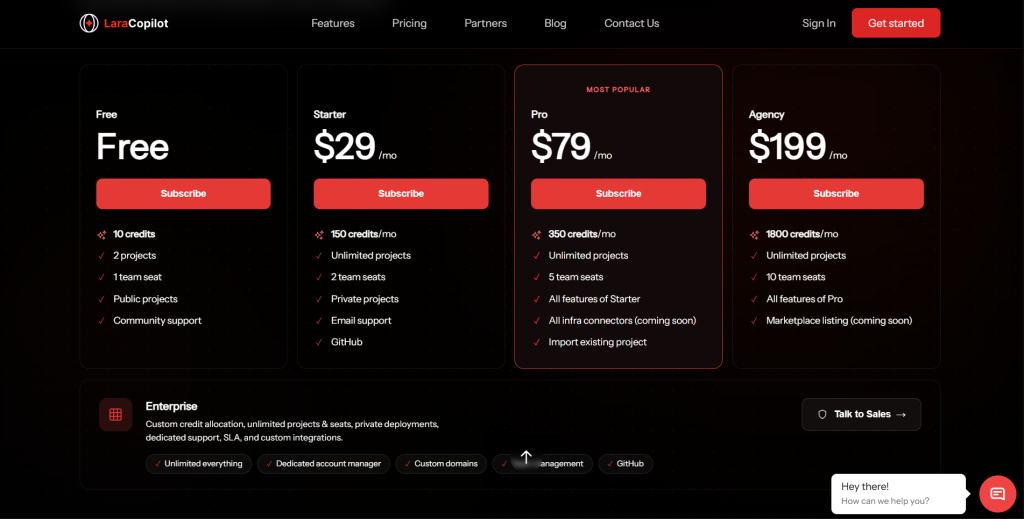
Start with LaraCopilot Agency Plan.

Laravel Code Review Checklist for Agencies (2026 Guide)

Let’s be honest.

Most Laravel agencies don’t struggle with talent.

They struggle with consistency.

One developer writes clean, scalable code.

Another ships something that works… but creates problems later.

Same team. Same project.

Different standards.

That’s where things start to break:

  • inconsistent code quality
  • longer review cycles
  • hidden bugs in production
  • frustrated senior developers

And over time?

Your delivery slows down, even if your team grows.

Why Most Laravel Code Reviews Fail

Code reviews are supposed to improve quality.

But in many teams, they become:

  • subjective
  • inconsistent
  • dependent on who reviews

One reviewer focuses on performance.

Another focuses on formatting.

Someone else just checks “does it work?”

The Real Problem

There’s no standard checklist.

And without a checklist:

Code review becomes opinion, not process.

What a Good Laravel Code Review Should Do

A strong review process should:

  • catch issues before production
  • enforce team-wide standards
  • reduce back-and-forth
  • make junior developers better

Not slow things down.

Laravel Code Review Checklist (Agency Standard)

Let’s break this into practical sections you can actually use.

1. Code Style & Formatting (First Filter)

Start here.

If formatting is wrong, everything else is noise.

What to Check

  • PSR-12 compliance
  • consistent indentation
  • proper naming conventions
  • no unused imports

Best Practice

Use Laravel Pint.

And in CI:

./vendor/bin/pint --test

Why This Matters

  • removes subjective feedback
  • speeds up reviews
  • avoids unnecessary comments

2. Logic & Structure (Does It Scale?)

This is where most issues hide.

What to Look For

  • is logic inside controllers minimal?
  • are services/repositories used properly?
  • is business logic reusable?

Red Flags

  • fat controllers
  • duplicated logic
  • unclear method responsibilities

Real Insight

If logic is hard to read, it’s hard to maintain.

3. Database & Query Optimization (Critical)

This is where production issues start.

What to Check

  • N+1 queries
  • proper eager loading
  • correct indexing usage
  • unnecessary queries

Example Problem

$users = User::all();

foreach ($users as $user) {
    echo $user->posts;
}

Fix

$users = User::with('posts')->get();

Why This Matters

Bad queries can slow your app by 2–10x. You need to optimize performance.

4. Validation & Security (Non-Negotiable)

Never skip this.

What to Check

  • input validation (Form Requests preferred)
  • authorization (policies, gates)
  • no raw SQL injections
  • proper escaping

Common Mistake

Skipping validation in “internal tools”

→ still dangerous

Real Insight

Security bugs are not visible — until they are critical.

5. Testing (Does It Break Later?)

Code without tests = future problems.

What to Check

  • does this feature have tests?
  • are edge cases covered?
  • are tests meaningful or superficial?

Minimum Standard

  • feature tests for endpoints
  • unit tests for core logic

Why This Matters

  • reduces regressions
  • increases confidence
  • speeds up deployment

Modern teams are also using AI to build Laravel apps with AI while ensuring tests are generated alongside features.

6. API & Response Consistency

Especially important for SaaS products.

What to Check

  • consistent response structure
  • proper status codes
  • error handling

Bad Example

{ "status": "ok" }

Better

{
  "success": true,
  "data": {...}
}

7. Naming & Readability

This sounds basic. It’s not.

What to Check

  • meaningful variable names
  • clear method names
  • no abbreviations

Real Insight

Code is read more than it is written.

8. Reusability & DRY Principle

What to Check

  • repeated logic
  • reusable services
  • shared helpers

Red Flag

Same logic copied in multiple controllers.

9. Error Handling & Logging

What to Check

  • proper exception handling
  • meaningful logs
  • no silent failures

Why This Matters

Debugging production issues becomes easier.

10. Deployment Awareness

Most developers ignore this.

What to Check

  • migrations safe?
  • backward compatibility maintained?
  • config changes handled?

Real Insight

Good code that breaks deployment is still bad code.

Ready to Code Smarter with Laravel?

Meet LaraCopilot — your AI full-stack assistant built for Laravel developers.
Skip the boilerplate, build faster, and focus on what matters: problem solving.

Try LaraCopilot Now

Quick Summary (What Reviewers Should Scan)

Before approving any PR:

  • formatting passes (Pint)
  • no N+1 queries
  • validation + security in place
  • tests added
  • logic is clean and reusable

If these are covered:

→ you’re already ahead of most teams

The Real Problem in Agency Teams

Let’s address reality.

Even with a checklist:

  • junior developers miss things
  • reviewers get tired
  • deadlines push compromises

That’s why quality becomes inconsistent.

How Modern Teams Solve This

They don’t rely only on reviews.

They improve what goes into the PR.

How LaraCopilot Helps You Pass Code Review First Time

Instead of:

  • writing code
  • waiting for review
  • fixing issues

You start with better code. You can start with Agency Plan in LaraCopilot.

With LaraCopilot, you describe what you want:

→ “Build feature with validation, tests, and optimized queries”

And it generates:

  • structured Laravel code
  • proper validation
  • clean formatting
  • optimized queries

What This Changes

Instead of fixing issues later:

→ you prevent them earlier

Real Impact

Teams using AI-assisted workflows:

  • reduce review cycles by 40–60%
  • ship faster
  • maintain consistency across developers

What We Learned Reviewing 1,000+ Laravel PRs

Let me share something most checklists won’t tell you.

The biggest problem in code reviews is not bad code.

It’s late feedback.

By the time a PR reaches review:

  • the developer is already mentally done
  • context has faded
  • changes feel “expensive”

So even when issues are found…

They either:

  • get patched quickly (not fixed properly)
  • or ignored to “move fast”

The Pattern We Noticed

Across hundreds of PRs, the same thing kept happening:

  • junior developers focused on “making it work”
  • reviewers focused on “fixing what’s wrong”

But no one focused on:

writing it right the first time

What Actually Works

The teams that scaled quality didn’t improve reviews.

They improved pre-review discipline.

Before opening a PR, developers would ask:

  • Would I approve this myself?
  • Is this production-ready?
  • Did I check queries, validation, and edge cases?

This simple shift changed everything.

The Real Insight

Code review should be a confirmation step, not a correction step.

Why This Matters for You

If your team relies heavily on reviewers to “clean things up”:

  • your delivery will slow down
  • your best developers will burn out
  • your quality will always fluctuate

But if your team starts shipping review-ready code:

  • PR cycles shrink
  • confidence increases
  • consistency becomes default

That’s the difference between teams that “manage code”…

and teams that scale systems.

PR Self-Check: Before You Request Review

Before you click “Create Pull Request”, pause for 2 minutes and run through this.

If you can’t confidently say “yes” to most of these, it’s not ready yet.

Logic & Structure

  • Does this code solve the problem clearly (not just “works”)?
  • Is business logic placed outside controllers (services, actions, etc.)?
  • Is anything unnecessarily complex or over-engineered?

Database & Performance

  • Did I avoid N+1 queries?
  • Am I using eager loading where needed?
  • Am I querying only the data I actually need?

Validation & Security

  • Are all inputs properly validated (Form Requests preferred)?
  • Is authorization handled (policies/gates)?
  • Am I avoiding any unsafe queries or exposed data?

Testing

  • Did I add tests for this feature?
  • Are edge cases covered (not just happy path)?
  • Would I trust this in production without manual testing?

Code Quality

  • Does this pass Laravel Pint (-test)?
  • Are variable and method names clear and meaningful?
  • Is there any duplicate or unnecessary code?

Reusability

  • Can any part of this be reused elsewhere?
  • Did I avoid copying logic across files?

Deployment Awareness

  • Are migrations safe to run in production?
  • Will this break anything existing?
  • Are configs/env changes handled properly?

Final Question (Most Important)

If this PR went to production right now…

would I be confident?

If the answer is not a clear yes, fix it before requesting review.

The Shift in 2026

Code reviews are not going away.

But they are changing.

From:

→ catching mistakes

To:

→ validating already good code

This is part of a larger shift toward an AI-powered Laravel development workflow.

Ready to Code Smarter with Laravel?

Meet LaraCopilot — your AI full-stack assistant built for Laravel developers.
Skip the boilerplate, build faster, and focus on what matters: problem solving.

Try LaraCopilot Now

Closing!

The best teams don’t rely on better reviewers.

They rely on better inputs.

AI-Generated Clean Code → Your Advantage

If you want:

  • consistent code quality
  • faster PR approvals
  • fewer production issues

Start generating clean Laravel code with LaraCopilot.

Laravel CI CD Pipeline Setup with GitHub Actions Guide

If you are still deploying your Laravel app manually, you are taking unnecessary risk. Manual deployments are slow, error‑prone, and impossible to scale when you have multiple environments, feature branches, and teams.

As a senior Laravel developer, you already know you need a CI/CD pipeline: every push should trigger linting, tests, build steps, and a safe, repeatable deployment to production.

In this guide, we’ll set up a Laravel CI/CD pipeline with GitHub Actions that:

  • Runs Pint for code style
  • Runs PHPUnit (and Pest) tests
  • Builds frontend assets (Vite)
  • Deploys to Laravel Cloud (or a similar platform)
  • Integrates cleanly with tools like LaraCopilot for AI‑assisted workflows

By the end, you’ll have a production‑grade Laravel CI/CD pipeline you can reuse across projects.

Why Your Laravel Project Needs CI/CD

Manual deployment problems you already know:

  • You forget a migration or cache clear.
  • A “quick hotfix” breaks another area because tests didn’t run.
  • You deploy from your laptop with uncommitted changes.
  • You can’t easily roll back.

A Laravel CI/CD pipeline with GitHub Actions solves this:

  • Every push triggers the same repeatable workflow.
  • Style violations fail fast (Pint), before code review.
  • Tests run before anything reaches staging/production.
  • Deployments happen from a clean, reproducible build, not a developer machine.

Once this is in place, the deployment process becomes:

Push to main → GitHub Actions runs lint + tests + build → auto‑deploy to Laravel Cloud if everything passes.

Architecture of a Laravel CI/CD Pipeline

Before we start writing YAML, let’s design the pipeline at a high level.

1. Trigger Strategy

You typically want:

  • On pull requests to develop/main: run lint + tests (CI).
  • On push to main (or release/*): run lint + tests + build + deploy (CD).

2. Pipeline Stages

We’ll structure a full pipeline:

  1. Code Quality / Lint
    • Run Laravel Pint.
  2. Automated Tests
    • Run unit, feature, and integration tests (PHPUnit or Pest).
  3. Build
    • Install Node dependencies.
    • Build frontend assets with Vite.
  4. Deploy
    • Ship to Laravel Cloud (or another host) using an API key/CLI.

You can keep these as a single GitHub Actions workflow with multiple jobs, or split into separate workflows (CI and CD). For clarity, we’ll show a combined approach and call out where you might split.

Prerequisites

Before setting up the workflow, make sure you have:

  • A Laravel app in a GitHub repo.
  • GitHub Actions enabled for the repository.
  • A Laravel Cloud project or another hosting target (e.g., Forge, Vapor, custom server).
  • Deployment credentials:
    • API token or SSH key for your hosting provider.
    • Stored as GitHub Secrets.
  • PHP test suite in place (PHPUnit / Pest).
  • Laravel Pint installed (globally or via dev dependency).

For Laravel Pint via Composer:

composer require laravel/pint --dev

Setting Up GitHub Secrets

You should never hard‑code secrets in your workflow file. Instead, configure:

  • LARAVEL_CLOUD_API_TOKEN
  • LARAVEL_CLOUD_PROJECT_ID
  • Any environment‑specific variables: APP_ENV, APP_KEY, DB_* if needed for integration tests.

In GitHub:

  1. Go to your repo → Settings → Secrets and variables → Actions.
  2. Click New repository secret.
  3. Add your tokens/keys.

We’ll reference these secrets in the YAML later.

Base GitHub Actions Workflow File

Create the workflow:

mkdir -p .github/workflows
touch .github/workflows/laravel-ci-cd.yml

We’ll build it step by step.

Step 1: Define Triggers and Basic Configuration

Start with the top of the workflow:

name: Laravel CI CD Pipeline

on:
  push:
    branches: [ main ]
  pull_request:
    branches: [ main, develop ]

jobs:
  # Jobs will go here
  • Pull requests to main or develop: run CI (lint + tests).
  • Push to main: run full CI + CD (including deploy).

Step 2: CI Job – Lint and Test

We’ll create a ci job that runs for both PRs and pushes.

jobs:
  ci:
    runs-on: ubuntu-latest

    services:
      mysql:
        image: mysql:8
        env:
          MYSQL_DATABASE: laravel
          MYSQL_USER: laravel
          MYSQL_PASSWORD: secret
          MYSQL_ROOT_PASSWORD: root
        ports:
          - 3306:3306
        options: >-
          --health-cmd="mysqladmin ping -h 127.0.0.1 -u laravel --password=secret"
          --health-interval=10s
          --health-timeout=5s
          --health-retries=3

    steps:
      - name: Checkout code
        uses: actions/checkout@v4

      - name: Setup PHP
        uses: shivammathur/setup-php@v2
        with:
          php-version: '8.2'
          extensions: mbstring, intl, pdo_mysql
          coverage: none

      - name: Cache Composer dependencies
        uses: actions/cache@v4
        with:
          path: vendor
          key: composer-${{ hashFiles('**/composer.lock') }}
          restore-keys: composer-

      - name: Install Composer dependencies
        run: composer install --no-interaction --prefer-dist --no-progress

      - name: Copy .env
        run: cp .env.example .env

      - name: Generate app key
        run: php artisan key:generate

      - name: Configure test database
        run: |
          php artisan config:clear
          php artisan migrate --force
        env:
          DB_CONNECTION: mysql
          DB_HOST: 127.0.0.1
          DB_PORT: 3306
          DB_DATABASE: laravel
          DB_USERNAME: laravel
          DB_PASSWORD: secret

      - name: Run Laravel Pint
        run: ./vendor/bin/pint

If you want Pint to only check and not auto‑fix, add --test:

    - name: Run Laravel Pint
        run: ./vendor/bin/pint --test

Now add the test step (PHPUnit or Pest):

      - name: Run tests
        run: php artisan test
        env:
          DB_CONNECTION: mysql
          DB_HOST: 127.0.0.1
          DB_PORT: 3306
          DB_DATABASE: laravel
          DB_USERNAME: laravel
          DB_PASSWORD: secret

At this point, you already have a functioning CI pipeline:

  • Every PR and push runs Pint and tests.
  • Failures block merges and deployments.

Step 3: Build Job – Frontend Assets (Vite)

For many apps, you also need to build assets before deploying. We’ll create a dedicated build job that depends on ci.

  build:
    runs-on: ubuntu-latest
    needs: ci
    if: github.ref == 'refs/heads/main'

    steps:
      - name: Checkout code
        uses: actions/checkout@v4

      - name: Setup Node
        uses: actions/setup-node@v4
        with:
          node-version: '20'

      - name: Cache node modules
        uses: actions/cache@v4
        with:
          path: node_modules
          key: node-${{ hashFiles('**/package-lock.json') }}
          restore-keys: node-

      - name: Install Node dependencies
        run: npm ci

      - name: Build assets
        run: npm run build

Notes:

  • We restrict this job to main using if: github.ref == 'refs/heads/main'.
  • You can later archive built assets as artifacts, or deploy from this job directly.

Step 4: CD Job – Deploy to Laravel Cloud

Now we’ll add a deploy job that runs after build succeeds and only on main.

You’ll need a deployment mechanism:

  • Laravel Cloud CLI or API.
  • Or another provider’s CLI (Forge, Vapor, etc.).
  • We’ll assume a simple CLI/API command.

Example:

  deploy:
    runs-on: ubuntu-latest
    needs: build
    if: github.ref == 'refs/heads/main'

    steps:
      - name: Checkout code
        uses: actions/checkout@v4

      - name: Setup PHP
        uses: shivammathur/setup-php@v2
        with:
          php-version: '8.2'

      - name: Setup Node
        uses: actions/setup-node@v4
        with:
          node-version: '20'

      - name: Install Composer dependencies (production)
        run: composer install --no-interaction --prefer-dist --no-dev --no-progress

      - name: Install Node dependencies
        run: npm ci

      - name: Build assets
        run: npm run build

      - name: Deploy to Laravel Cloud
        env:
          LARAVEL_CLOUD_API_TOKEN: ${{ secrets.LARAVEL_CLOUD_API_TOKEN }}
          LARAVEL_CLOUD_PROJECT_ID: ${{ secrets.LARAVEL_CLOUD_PROJECT_ID }}
        run: |
          # Example pseudo command – replace with real CLI/API call
          curl -X POST \\
            -H "Authorization: Bearer $LARAVEL_CLOUD_API_TOKEN" \\
            -H "Content-Type: application/json" \\
            -d '{"project_id": "'"$LARAVEL_CLOUD_PROJECT_ID"'", "branch": "main"}' \\
            <https://api.laravelcloud.com/deploy>

Adjust the deploy command to match your actual provider. The key ideas:

  • Deployment runs only after CI and build pass.
  • Deployment runs only for main.
  • Secrets stay in GitHub, not in the repo.

Handling Multiple Environments (Staging, Production)

Senior teams often want:

  • PR → run CI only.
  • Merge to develop → deploy to staging.
  • Merge to main → deploy to production.

You can handle this using environments:

  deploy:
    runs-on: ubuntu-latest
    needs: build
    environment:
      name: production
      url: <https://your-production-app.com>
    if: github.ref == 'refs/heads/main'

And a second deploy job for staging:

  deploy_staging:
    runs-on: ubuntu-latest
    needs: ci
    environment:
      name: staging
      url: <https://staging-your-app.com>
    if: github.ref == 'refs/heads/develop'
    # staging deploy steps...

GitHub environments allow:

  • Manual approvals before production deploy.
  • Environment‑specific secrets.

Optimizing Performance: Caching and Matrix Builds

For mature teams, the next pain point is pipeline speed. Some optimizations:

Composer and Node Caching

We already added caches, but you can tune them if you have multiple workflows:

  • Use consistent keys across workflows.
  • Cache built Vite assets if needed.

Matrix for PHP Versions

If you maintain packages or broad PHP version support, use a matrix:

  ci:
    runs-on: ubuntu-latest
    strategy:
      matrix:
        php-version: ['8.1', '8.2']
    steps:
      - uses: shivammathur/setup-php@v2
        with:
          php-version: ${{ matrix.php-version }}
          extensions: mbstring, intl, pdo_mysql

You can still restrict deploy to a single run on a specific version.

Integrating Laravel GitHub Actions With Automated Testing Culture

The value of a Laravel GitHub Actions pipeline depends on the quality of your test suite and conventions. A few patterns that work well in senior teams:

  • Fail fast on style: run Pint first. No point running tests if the codebase doesn’t meet standards.
  • Separate quick tests and slow suites:
    • Run unit tests on every PR.
    • Run full integration/end‑to‑end tests on main and nightly.
  • Use coverage for critical modules only: keep CI fast by avoiding heavy coverage runs on every push.

You can also integrate code coverage or static analysis (PHPStan, Psalm):

      - name: Run PHPStan
        run: ./vendor/bin/phpstan analyse --memory-limit=1G

Connecting This Pipeline With AI-Powered Tools (LaraCopilot)

Your CI/CD pipeline is already doing what it’s supposed to do. It runs Pint, executes tests, builds your app, and deploys it. That part is not the problem.

The real friction shows up before CI even starts, when developers push code that isn’t fully ready. You’ve probably seen this yourself: a feature gets pushed, CI runs, and something fails. Maybe formatting is off, maybe a test is missing, maybe a small edge case was ignored. The pipeline fails, the developer fixes it, pushes again, and waits for CI to rerun. This loop repeats more often than it should.

That’s exactly where LaraCopilot fits in not inside your CI/CD pipeline, but right before it.

Instead of writing everything manually and relying on CI to catch issues, you start with intent. You describe what you want to build, and LaraCopilot helps generate structured Laravel code, including a solid starting point for tests and code that already follows common formatting conventions. It’s not about replacing your workflow, it’s about reducing the friction inside it.

What changes in practice is simple. Instead of “write → push → fail → fix → push again,” your flow becomes “generate → refine → push → pass.” CI/CD still does its job, but now it’s validating good code instead of catching avoidable mistakes.

Because your pipeline runs on GitHub Actions, this fits naturally into your existing setup. Every push still triggers linting, testing, and deployment. The difference is that developers spend less time reacting to CI failures and more time building actual features.

The key thing to understand is this: CI/CD doesn’t improve your code, it enforces standards. The real improvement happens before the code ever reaches the pipeline. That’s the gap LaraCopilot helps close.

Common Pitfalls and How to Avoid Them

Even senior Laravel developers run into similar issues when setting up a Laravel deployment pipeline for the first time:

  1. Environment drift
    • Local .env and CI .env differ.
    • Fix: explicitly define environment variables in CI and ensure they match staging/production config.
  2. Database dependency in tests
    • Tests rely on a database state not properly seeded in CI.
    • Fix: use migrations + seeders or dedicated test factories in the CI job.
  3. Long‑running pipelines
    • Too many heavy tests or unnecessary steps on every push.
    • Fix: split workflows (PR vs main) and move heavy jobs to nightly or main branch only.
  4. Fragile deploy scripts
    • Hand‑rolled scripts that break with small environment changes.
    • Fix: prefer provider CI integrations or stable CLIs, keep scripts minimal and idempotent.

Putting It All Together: Example Full Workflow

Here is a consolidated example you can adapt:

name: Laravel CI CD Pipeline

on:
  push:
    branches: [ main, develop ]
  pull_request:
    branches: [ main, develop ]

jobs:
  ci:
    runs-on: ubuntu-latest

    services:
      mysql:
        image: mysql:8
        env:
          MYSQL_DATABASE: laravel
          MYSQL_USER: laravel
          MYSQL_PASSWORD: secret
          MYSQL_ROOT_PASSWORD: root
        ports:
          - 3306:3306
        options: >-
          --health-cmd="mysqladmin ping -h 127.0.0.1 -u laravel --password=secret"
          --health-interval=10s
          --health-timeout=5s
          --health-retries=3

    steps:
      - uses: actions/checkout@v4

      - uses: shivammathur/setup-php@v2
        with:
          php-version: '8.2'
          extensions: mbstring, intl, pdo_mysql

      - uses: actions/cache@v4
        with:
          path: vendor
          key: composer-${{ hashFiles('**/composer.lock') }}
          restore-keys: composer-

      - name: Install Composer dependencies
        run: composer install --no-interaction --prefer-dist --no-progress

      - name: Copy .env
        run: cp .env.example .env

      - name: Generate app key
        run: php artisan key:generate

      - name: Run migrations
        run: php artisan migrate --force
        env:
          DB_CONNECTION: mysql
          DB_HOST: 127.0.0.1
          DB_PORT: 3306
          DB_DATABASE: laravel
          DB_USERNAME: laravel
          DB_PASSWORD: secret

      - name: Run Laravel Pint
        run: ./vendor/bin/pint --test

      - name: Run tests
        run: php artisan test
        env:
          DB_CONNECTION: mysql
          DB_HOST: 127.0.0.1
          DB_PORT: 3306
          DB_DATABASE: laravel
          DB_USERNAME: laravel
          DB_PASSWORD: secret

  build:
    runs-on: ubuntu-latest
    needs: ci
    if: github.ref == 'refs/heads/main'

    steps:
      - uses: actions/checkout@v4

      - uses: actions/setup-node@v4
        with:
          node-version: '20'

      - uses: actions/cache@v4
        with:
          path: node_modules
          key: node-${{ hashFiles('**/package-lock.json') }}
          restore-keys: node-

      - name: Install Node dependencies
        run: npm ci

      - name: Build assets
        run: npm run build

  deploy:
    runs-on: ubuntu-latest
    needs: build
    if: github.ref == 'refs/heads/main'
    environment:
      name: production

    steps:
      - uses: actions/checkout@v4

      - uses: shivammathur/setup-php@v2
        with:
          php-version: '8.2'

      - uses: actions/setup-node@v4
        with:
          node-version: '20'

      - name: Install Composer dependencies (production)
        run: composer install --no-interaction --prefer-dist --no-dev --no-progress

      - name: Install Node dependencies
        run: npm ci

      - name: Build assets
        run: npm run build

      - name: Deploy to Laravel Cloud
        env:
          LARAVEL_CLOUD_API_TOKEN: ${{ secrets.LARAVEL_CLOUD_API_TOKEN }}
          LARAVEL_CLOUD_PROJECT_ID: ${{ secrets.LARAVEL_CLOUD_PROJECT_ID }}
        run: |
          # Replace with your actual deployment command
          curl -X POST \\
            -H "Authorization: Bearer $LARAVEL_CLOUD_API_TOKEN" \\
            -H "Content-Type: application/json" \\
            -d '{"project_id": "'"$LARAVEL_CLOUD_PROJECT_ID"'", "branch": "main"}' \\
            <https://api.laravelcloud.com/deploy>

Use this as a template and adapt for your hosting environment and stack.

Where to Go Next

Once your Laravel CI/CD pipeline with GitHub Actions is running end-to-end, you’ve already solved the hardest part. Your deployments are no longer manual, your tests run automatically, and your code is validated before it reaches production.

From here, the focus shifts from “getting CI/CD working” to making it smarter and more reliable over time.

You can start tightening quality by introducing deeper checks like static analysis (PHPStan or Psalm) or even mutation testing if you want to push test reliability further. As your application grows, you might also look into safer deployment strategies like canary releases or blue-green deployments, especially if downtime or risky releases become a concern.

This is also the stage where your development workflow and CI/CD pipeline start to connect more closely. Tools like LaraCopilot can help earlier in the process during development and pull requests, so that by the time code reaches your pipeline, it’s already cleaner, better structured, and less likely to fail.

If you want to go deeper into deployment automation and AI-assisted Laravel workflows, it’s worth exploring how modern teams are combining both to move faster without breaking things.

And if you’ve made it this far, you already know the real shift isn’t just automation, it’s confidence.

You’re no longer shipping from your laptop.

You’re shipping through a system.

Automate Your Deploy with LaraCopilot

Laravel Query Builder Best Practices 2026 (Full Guide)

Let’s get straight to it.

Your Laravel app is not slow because of Laravel.

It’s slow because of how queries are written.

Everything works fine in development.

Small dataset. Fast responses. No issues.

Then production happens.

Suddenly:

  • queries slow down
  • pages lag
  • CPU usage spikes

And now you’re debugging performance instead of building features.

This guide will fix that not with random tips, but with how to think about queries properly in 2026.

Why Most Laravel Apps Become Slow

Most performance issues don’t come from architecture.

They come from small mistakes repeated everywhere.

Things like:

  • loading too much data
  • missing eager loading
  • filtering in memory
  • unnecessary queries

Individually, they seem harmless.

Together?

They slow your app down by 2–10x.

Eloquent Is Not the Problem

Let’s clear this upfront.

Eloquent is not slow.

Bad usage of Eloquent is slow.

You don’t need to switch to raw queries.

You don’t need to avoid relationships.

You need to understand what your code translates to in SQL.

That’s the shift:

Stop thinking in Laravel code. Start thinking in queries.

The N+1 Query Problem (And How to Fix It)

This is still the biggest issue in Laravel apps.

And it still happens everywhere.

What N+1 Looks Like

$users = User::all();

foreach ($users as $user) {
    echo $user->posts;
}

Looks fine.

But behind the scenes:

  • 1 query → users
  • N queries → posts

So if you have 100 users:

→ 101 queries

Fix It with Eager Loading

$users = User::with('posts')->get();

Now:

→ 2 queries total

Why This Still Breaks Apps in 2026

Because apps are more complex now.

You’re not just loading:

  • users → posts

You’re loading:

  • users → posts → comments → likes

Miss one eager load…

And performance drops instantly.

Stop Loading Unnecessary Data

This is one of the most ignored issues.

The Common Mistake

User::all();

You load:

  • all rows
  • all columns

Even if you only need:

→ id and name

The Better Approach

User::select('id', 'name')->get();

Why This Matters

Less data means:

  • faster queries
  • less memory
  • faster responses

In real-world apps, this alone improves performance by 20–40%.

Database Filtering vs Collection Filtering

This one looks small. It’s not.

The Wrong Way

User::all()->where('active', 1);

This filters in memory.

The Right Way

User::where('active', 1)->get();

Why It Matters

  • DB filtering → indexed, optimized
  • memory filtering → slow, heavy

The Rule

Always filter in the database.

Eager Loading Strategy (Think Before You Query)

Eager loading isn’t just about fixing N+1.

It’s about planning.

Basic Example

Post::with(['user', 'comments'])->get();

You’re saying:

→ “I will need this data”

Conditional Eager Loading

Post::when($withComments, function ($query) {
    $query->with('comments');
})->get();

Why This Matters

  • avoids unnecessary queries
  • keeps responses lean
  • adapts to context

Handling Large Data: Chunking & Streaming

If you’re working with large datasets, stop using all().

The Problem

User::all();

This loads everything into memory.

The Right Way

User::chunk(100, function ($users) {
    foreach ($users as $user) {
        // process
    }
});

Why This Matters

  • prevents memory issues
  • scales with data
  • keeps your app stable

Real Insight

Chunking isn’t optimization.

It’s survival.

Database Indexing (The Silent Performance Multiplier)

Most slow queries are not Laravel problems.

They’re database problems.

What You Should Index

  • foreign keys
  • search columns
  • sorting columns

Real Impact

Proper indexing can improve speed by 50–80%.

Simple Rule

If you query it often, index it.

Avoid Loops: Use Bulk Operations

Loops kill performance faster than you think.

The Wrong Way

foreach ($users as $user) {
    $user->update(['active' => 1]);
}

The Right Way

User::where(...)->update(['active' => 1]);

Why This Matters

  • fewer queries
  • faster execution
  • less DB load

Pagination Is Mandatory (Not Optional)

Returning large datasets without pagination?

That’s a problem.

Use This

User::paginate(10);

Why It Matters

  • faster responses
  • better UX
  • reduced memory usage

How to Debug Slow Queries (Like a Senior Developer)

Most developers guess.

Senior developers measure.

Use Tools

  • Laravel Telescope
  • Debugbar
  • query logs

What to Check

  • query count
  • execution time
  • duplicate queries

Real Insight

You can’t fix what you don’t measure.

Writing Maintainable Queries with Scopes

As your app grows, inline queries become messy.

Use Scopes

public function scopeActive($query)
{
    return $query->where('active', 1);
}

Then:

User::active()->get();

Why This Matters

  • reusable logic
  • cleaner code
  • easier maintenance

2026 Shift: From Writing Queries to Generating Them

This is where things are changing.

Developers are no longer:

→ writing everything manually

They’re:

→ generating optimized queries

How LaraCopilot Helps You Write Better Queries

Let’s keep this practical.

Normally, you:

  • write query
  • test it
  • optimize later

With LaraCopilot, you start differently.

You describe:

→ “Fetch active users with posts, optimized for performance”

And it generates:

  • correct eager loading
  • proper filtering
  • efficient structure

What This Changes

Instead of fixing bad queries later…

You start with good ones.

Real Impact

Teams using AI-assisted workflows:

  • reduce query issues by 40–60%
  • ship faster
  • debug less

The Real Shift

Performance is no longer something you fix later.

It’s something you generate from the start.

If you want to go deeper into relationships, check this guide on Laravel Eloquent relationships with AI.

Common Laravel Query Mistakes (Quick Recap)

Let’s simplify everything.

  • loading unnecessary data
  • ignoring eager loading
  • filtering in memory
  • missing indexes
  • looping instead of batching

Fix these, and your app becomes significantly faster.

Ready to Code Smarter with Laravel?

Meet LaraCopilot — your AI full-stack assistant built for Laravel developers.
Skip the boilerplate, build faster, and focus on what matters: problem solving.

Try LaraCopilot Now

Final Thought: Think in Queries, Not Code

This is the biggest mindset shift.

Most developers think:

→ “What code should I write?”

Better developers think:

→ “What query will this generate?”

That’s the difference between:

  • working code
  • scalable code

Generate Optimized Code From Day One

If you want:

  • faster queries
  • cleaner logic
  • fewer performance issues

Start building with LaraCopilot.

Laravel Pint Test Dry Run: CI/CD Integration Guide

If you’re using Laravel Pint in CI…

You’ve probably hit this confusion:

“How do I check code style without auto-fixing it?”

Because locally:

→ Pint fixes everything

But in CI:

→ you want to fail the build if code is not formatted

That’s where laravel pint test dry run comes in.

And yes — the docs don’t make this obvious.

What Does -test Actually Do in Laravel Pint?

This is the key flag:

./vendor/bin/pint --test

What It Does

  • checks code formatting
  • does NOT modify files
  • exits with non-zero status if issues found

What That Means in CI

  • clean code → build passes
  • formatting issues → build fails

Real Insight

--test turns Pint from a formatter into a validator

Why You Should Use Pint in CI/CD

Code style is not just aesthetics.

It’s:

  • consistency across teams
  • easier code reviews
  • fewer merge conflicts

Real Data

  • consistent formatting reduces review time by 20–30%
  • teams using automated linters see fewer style-related PR comments

The Problem Without -test

If you run:

./vendor/bin/pint

In CI:

  • it auto-fixes files
  • CI environment doesn’t commit changes
  • results become inconsistent

Result

→ unreliable pipelines

Correct Approach

Always use:

./vendor/bin/pint --test

Basic CI Example (GitHub Actions)

Here’s a clean setup:

name: Pint Check

on: [push, pull_request]

jobs:
  pint:
    runs-on: ubuntu-latest

    steps:
      - uses: actions/checkout@v3

      - name: Setup PHP
        uses: shivammathur/setup-php@v2
        with:
          php-version: 8.2

      - name: Install dependencies
        run: composer install --no-progress --prefer-dist

      - name: Run Pint (Test Mode)
        run: ./vendor/bin/pint --test

GitLab CI Example

pint:
  script:
    - composer install
    - ./vendor/bin/pint --test

Common Mistakes Developers Make

Running Pint Without -test

Leads to:

  • silent fixes
  • inconsistent CI

Ignoring Exit Codes

CI must fail if formatting fails.

Not Standardizing Rules

Different configs = chaos

Customizing Pint Rules (CI Friendly)

You can define rules in:

pint.json

Example

{
  "preset": "laravel",
  "rules": {
    "array_syntax": {
      "syntax": "short"
    }
  }
}

Best Practice

  • keep rules minimal
  • align with team standards

Pre-Commit Hook (Prevent CI Failures)

Instead of failing CI…

Fix issues before push.

Example

./vendor/bin/pint

Run locally before commit.

Better Workflow

  • local → auto-fix
  • CI → validate

Combining Pint with Other Tools

For full quality pipeline:

  • Pint → code style
  • PHPStan → static analysis
  • PHPUnit → tests

Real Insight

Pint ensures readability.

Other tools ensure correctness.

Performance Tip (Speed Up CI)

Run Pint only on changed files:

git diff --name-only origin/main | xargs ./vendor/bin/pint --test

Result

  • faster CI
  • less resource usage

Where LaraCopilot Fits In

Here’s the modern advantage.

Instead of:

  • fixing formatting manually
  • relying on CI failures

You generate:

→ clean code from the start

What This Means

LaraCopilot:

  • follows Laravel coding standards
  • applies Pint-compatible formatting
  • reduces CI failures

If you want to understand how this works, this guide on how LaraCopilot generates production grade Laravel code explains it in detail.

Real Workflow (Modern Laravel Teams)

Instead of:

  • write code
  • fail CI
  • fix formatting

You:

  • generate clean code
  • validate in CI
  • ship faster

CI Should Enforce, Not Fix

That’s the mindset shift.

  • local → fix
  • CI → enforce

Making Pint Failures Developer-Friendly (Actionable CI Output)

One of the biggest frustrations with Pint in CI is this:

→ it fails… but doesn’t clearly tell developers what to fix

That slows teams down.

The Problem

Default output:

  • raw CLI logs
  • hard to scan in large PRs

Result:

→ developers waste time finding issues

The Better Approach

Use verbose + diff-style output:

./vendor/bin/pint--test-v

Even Better: Show Diff in CI

You can enhance visibility by running:

./vendor/bin/pint--test--diff

Why This Matters

Now developers see:

  • exactly which file failed
  • what needs to change
  • before/after formatting

Real Impact

Teams that improve CI feedback loops:

→ reduce fix time by 30–50%

Pro Tip

Combine with PR comments (GitHub Actions tools):

→ auto-comment formatting issues directly on PR

Insight

CI should not just fail — it should guide developers to fix faster.

Enforcing Code Style at Scale (Monorepo & Multi-Team Strategy)

This is where most teams struggle.

Pint works great…

Until your codebase grows.

Problem

In larger teams:

  • multiple developers
  • multiple services
  • inconsistent configs

Result:

→ formatting drift

Solution: Centralized Pint Strategy

1. Single Source of Truth

Keep one pint.json at root.

Avoid:

→ multiple configs

2. Enforce via CI Only (Not Optional)

Make Pint:

→ mandatory check

No bypass.

3. Version Lock Pint

Use fixed version:

composer require laravel/pint:^1.0

Why?

Different versions:

→ different formatting

4. Run Pint Only on Changed Files

In large repos:

gitdiff--name-only origin/main |grep .php | xargs ./vendor/bin/pint--test

Real Data

  • selective linting reduces CI time by 40–70%
  • large teams see fewer conflicts when formatting is standardized

5. Combine with Pre-Commit Hooks

CI enforcement is good.

But prevention is better.

Real Insight

The best teams don’t fix formatting in CI, they prevent bad formatting from reaching CI.

Running Pint is easy. Making it work well across a team is where most projects fail.

Laravel Pint CI Workflow (Fail → Fix → Pass)

Developer writes code
        │
        ▼
Runs locally (optional)
        │
        ▼
Push to GitHub / GitLab
        │
        ▼
CI Pipeline Starts
        │
        ▼
Run: pint --test
        │
        ▼
Is formatting correct?
   ┌───────────────┐
   │               │
   ▼               ▼
 YES             NO
 │                │
 ▼                ▼
Build Pass     Build Fails
 │                │
 ▼                ▼
Merge PR      Developer checks CI logs
                    │
                    ▼
          Run locally: pint
                    │
                    ▼
          Fix formatting issues
                    │
                    ▼
          Commit & push again
                    │
                    ▼
              CI runs again
                    │
                    ▼
               Build Pass 

What This Actually Teaches (Important)

This diagram clarifies something many teams get wrong:

Wrong Thinking

“CI will fix formatting”

Correct Workflow

  • local → fix
  • CI → validate

Optimized Team Workflow (Pro Version)

If you want to go one level deeper:

Developer writes code
        │
        ▼
Pre-commit hook runs Pint
        │
        ▼
Code already formatted 
        │
        ▼
Push to CI
        │
        ▼
CI runs pint --test
        │
        ▼
Always passes (no surprises)

Real Impact

Teams using this flow:

  • reduce CI failures by 70–90%
  • speed up PR merges
  • eliminate formatting noise in reviews

The goal of CI is not to catch mistakes, it’s to ensure mistakes never reach CI.

How LaraCopilot Helps You Avoid Pint CI Failures Entirely

Here’s the reality:

Most teams don’t struggle with Pint.

They struggle with:

  • inconsistent code style
  • repeated CI failures
  • wasted time fixing formatting

Traditional Workflow (What Happens Today)

  1. Developer writes code
  2. Pushes PR
  3. CI runs Pint
  4. Build fails
  5. Developer fixes formatting
  6. Push again

This loop:

→ wastes time

→ slows delivery

→ creates friction

LaraCopilot Workflow (What Changes)

With LaraCopilot:

  1. You describe what you want
  2. Code is generated
  3. Code already follows Laravel standards
  4. CI passes on first attempt

Why This Works

LaraCopilot doesn’t just generate code.

It generates:

  • Laravel-convention-aligned structure
  • clean formatting (Pint-compatible)
  • consistent patterns across files

Real Impact

Teams using AI-assisted generation:

  • reduce formatting-related CI failures by 60–80%
  • speed up PR cycles significantly
  • spend more time building, less time fixing

What This Means Practically

Instead of:

→ fixing code after writing

You:

→ generate clean code from the start

Strategic Shift (Important)

This is the real mindset change:

Code quality is no longer something you enforce after development, it’s something you generate by default.

Where This Fits in Your Workflow

Combine:

  • LaraCopilot → clean code generation
  • Pint (-test) → CI validation

Result:

→ zero-friction code quality pipeline

The fastest teams don’t write better code, they start with better code.

Quick Summary

  • use -test in CI
  • fail builds on style issues
  • fix locally

Ready to Code Smarter with Laravel?

Meet LaraCopilot — your AI full-stack assistant built for Laravel developers.
Skip the boilerplate, build faster, and focus on what matters: problem solving.

Try LaraCopilot Now

AI-Generated Clean Code

If you want:

  • fewer CI failures
  • consistent formatting
  • faster development

Generate clean Laravel code with LaraCopilot